On this page
- What the law and guidance require
- Canopy extraction for gas appliances
- Make-up air: the part most fit-outs get wrong
- How the gas interlock links to ventilation
- Who is responsible for kitchen ventilation?
- A fit-out checklist for gas catering kitchens
- Signs your existing kitchen ventilation is not coping
- Planning a kitchen fit-out in Staffordshire or Cheshire?
- Frequently asked questions
Key takeaways
- HSE guidance treats extraction, replacement air and gas safety as one system. A canopy with no proper make-up air does not meet the standard.
- Replacement air must come from outside and must not be drawn from bin stores, smoking areas or other dirty spaces.
- Where a canopy acts as the flue for gas cooking, the gas supply must be interlocked so it shuts off if the fans stop. BS 6173 asks for interlocks with any mechanical ventilation provided for safe operation.
- HSE catering guidance gives 2,800 ppm as the maximum carbon dioxide level in the kitchen atmosphere, which is why many interlock panels also carry a CO2 sensor.
- Plan ventilation before ordering appliances. The extract design depends on what you cook and on which appliances need a flue.
Commercial kitchen ventilation for gas appliances has three jobs: remove heat, fumes and products of combustion through a canopy and ductwork, bring in enough fresh replacement air from outside, and stop the gas from flowing if that airflow fails. In the UK the last part is done with a gas interlock under BS 6173, and the whole system has to be adequate under the Gas Safety (Installation and Use) Regulations 1998 and workplace law. Get the design right before the appliances go in and commissioning, inspection and your CP42 all go far more smoothly.
This guide is for restaurant, cafe and takeaway owners planning a new kitchen or reworking an old one. It explains what each part of the system does, what the rules actually say, and where a gas engineer fits into the job. If you want a deeper look at the safety control itself, our separate explainer on gas interlock systems covers how they work day to day.
What the law and guidance require
There is no single “kitchen ventilation regulation”. The requirements come from several places that overlap:
- Gas Safety (Installation and Use) Regulations 1998: gas appliances must be installed by a Gas Safe registered engineer and must have adequate ventilation and a safe route for combustion products.
- Workplace (Health, Safety and Welfare) Regulations 1992: employers must provide effective ventilation in enclosed workplaces.
- Health and Safety at Work etc Act 1974: the general duty to keep premises, plant and equipment safe.
- BS 6173: the British Standard for installing and maintaining gas-fired catering appliances, which engineers work to.
- BESA DW/172: the industry specification that ventilation designers use for kitchen extract systems.
HSE pulls these together in its catering information sheet CAIS10, Ventilation in catering kitchens. It says following the guidance is not compulsory, but doing so will normally be enough to comply with the law. That makes it the most useful single document for a business owner to read before a fit-out.
Canopy extraction for gas appliances
The canopy is the visible part: a stainless hood above the cooking line with grease filters, connected by ductwork to an extract fan that discharges outside. For gas cooking it does more than remove steam and smells. Most catering appliances under a canopy are flueless, which means their combustion products go straight into the kitchen air and rely on the extraction to carry them away.
HSE’s guidance sets out what a good canopy system looks like in practical terms:
- The hood sits as close to the cooking as practicable and covers every appliance that needs it.
- Airflow into the canopy is even and steady across its length, not strong at one end and weak at the other.
- Grease filters come out easily for cleaning or replacement.
- Ductwork has access panels so it can be cleaned regularly, because grease build-up is a fire risk.
- Canopies and ducts are made of non-combustible material that resists grease and condensation.
- The system runs quietly and without vibration, so staff do not turn it down or off to get some peace.
That last point is more important than it sounds. A fan that is too loud on full speed tends to get run on low or switched off during quiet periods. Many systems therefore set a minimum fan speed, so ventilation never drops below a safe level while the burners are lit.
Appliances that need a flue
Some catering equipment, often larger ovens and certain fryers, is designed to be flued. Manufacturer instructions decide whether a flued appliance can discharge under a canopy or needs its own flue connection. Where the extraction is serving as the flue, the canopy and fan effectively become a power-operated flue, and the gas supply must be interlocked to it. This is one reason to pick your equipment before the ventilation is designed, not after.
Make-up air: the part most fit-outs get wrong
Every cubic metre of air the canopy pulls out has to be replaced. If it is not, the kitchen goes into strong negative pressure. Doors slam, the fan struggles, and air gets dragged back down any route it can find, including flues from other appliances. Gas burners also need air to burn cleanly. Starve them and combustion gets worse.
HSE says replacement air should come from outside, be fresh, and not be drawn from areas such as waste storage or smoking shelters. In practice there are two ways to deliver it:
| Method | How it works | Points to watch |
|---|---|---|
| Natural make-up air | Permanent grilles or louvres to outside let air in as the fan draws it out | Grilles get blocked by boxes or taped over in winter; cold draughts on staff |
| Mechanical (powered) supply | A supply fan, often with a heater, pushes filtered outside air into the kitchen or the canopy front | Must be balanced with the extract and kept maintained; usually linked to the interlock |
Designers commonly supply slightly less air than is extracted, often around 85% in published design examples such as this Modern Building Services article, so the kitchen sits at a gentle negative pressure and cooking smells do not spill into the dining room. The exact balance is a design decision for your ventilation engineer, not a legal figure.
Blocked air inlets are named in HSE guidance as a fire risk. If staff have covered a grille because it is cold in January, that is a gas safety problem as well as a comfort one.
How the gas interlock links to ventilation
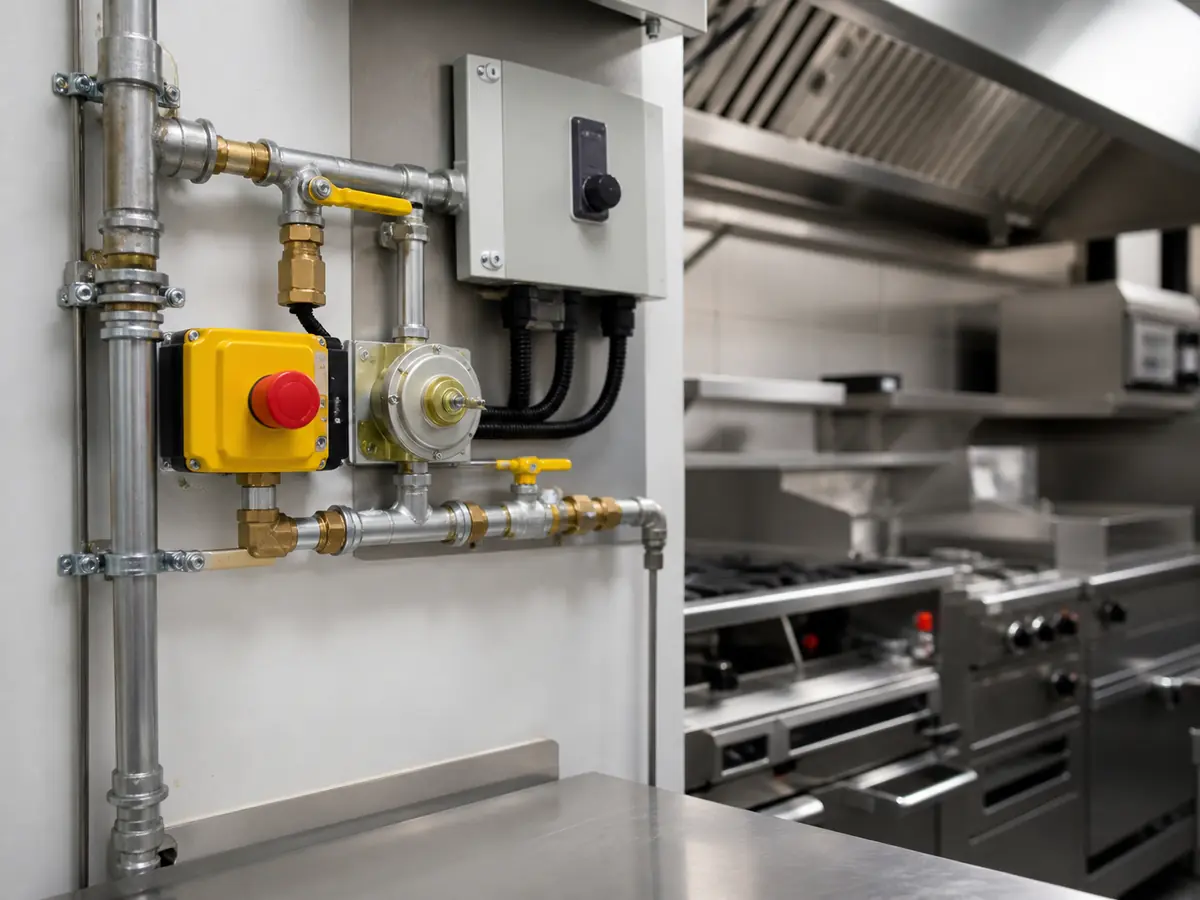
An interlock connects the ventilation to a gas solenoid valve on the kitchen supply. If the extract fan, and where fitted the supply fan, is not proving airflow, the solenoid will not open and the burners cannot be lit. If a fan fails mid-service, the gas shuts off.
According to the CIBSE Journal CPD module on commercial kitchen design, BS 6173 asks for appliances to be interlocked with any mechanical ventilation fitted for their safe operation, using a solenoid valve with no manual override. The same article notes that HSE catering guidance allows a maximum of 2,800 ppm carbon dioxide in the kitchen atmosphere. Many interlock panels carry a CO2 sensor that closes the gas valve if that level is reached, which protects staff even when the fans are running but cannot keep up.
For the controls, fan sensors and reset procedure, read our full guide to how gas interlock systems work.
Who is responsible for kitchen ventilation?
Responsibility is shared, and fit-outs go wrong when everyone assumes someone else has it covered.
| Party | What they are responsible for |
|---|---|
| Caterer / business owner | Telling the designers what will be cooked, which appliances, how many staff and opening hours; keeping the system clean and in use; consulting staff on changes |
| Landlord or building manager | Ventilation they provide as part of the premises |
| Ventilation designer | Sizing extract and make-up air for the appliances, heat load, cleaning access and hygiene |
| Gas Safe registered engineer | Installing and commissioning gas appliances and pipework, checking ventilation is adequate for the gas load, fitting or testing the interlock |
Gas engineers cannot design your extraction system for you, but they will refuse to commission appliances if ventilation is inadequate or the interlock does not work. It is far cheaper to involve them at the design stage than to discover a problem on handover day.
A fit-out checklist for gas catering kitchens
- Fix the menu and appliance list. Note which appliances are flued and their gas ratings from the manufacturer data plates or brochures.
- Brief a ventilation designer working to DW/172, with the appliance list and kitchen layout.
- Agree the make-up air route from outside, clear of bins and smoking areas.
- Plan the gas supply with your engineer, including pipe sizing for the total load, the emergency isolation valve and the interlock solenoid position. Our commercial kitchen gas pipe installation service covers this stage.
- Install canopy, ducts, fans and interlock panel before final gas connections.
- Commission the system: test fan proving, interlock shut-off, CO2 sensor if fitted, and appliance combustion.
- Get your CP42 commercial gas safety record once everything is installed and tested.
- Set a cleaning and maintenance schedule for filters, ductwork and fans, and train staff on the interlock reset.
Signs your existing kitchen ventilation is not coping
Older kitchens, or ones that have added appliances over the years, often have extraction that no longer matches the cooking load. Watch for:
- Staff with headaches, dizziness or tiredness that ease after leaving the kitchen. These can be signs of carbon monoxide exposure: switch off appliances, ventilate, get people into fresh air and seek medical advice. Our guide to carbon monoxide symptoms explains more.
- Heat and steam hanging in the kitchen even with fans on full.
- Doors that are hard to open or slam because of strong suction.
- Yellow or lazy burner flames, or soot marks on pans and walls.
- The interlock tripping repeatedly during busy service.
- Grease dripping from filters or visible in ductwork.
Any of these warrants a check by a Gas Safe engineer. Winter brings its own issues, from blocked grilles to frozen fan sensors, which we cover in our commercial kitchen winter gas checks. If you smell gas at any point, turn off the supply at the emergency control valve, do not use electrical switches, open windows and call the National Gas Emergency Service on 0800 111 999.
Planning a kitchen fit-out in Staffordshire or Cheshire?
Ventilation, make-up air and the interlock work as one system, and the gas side cannot be signed off until all three are right. Bring your gas engineer in early, give the designer an accurate appliance list, and keep replacement air routes clear once you are trading.
Gasmaster’s commercial catering gas engineers install and commission catering appliances, interlocks and pipework across Stoke-on-Trent, Staffordshire, Cheshire and Derbyshire. Contact us to talk through your kitchen plans or book a CP42 inspection.
[googlesitekit-end-of-content]
Frequently asked questions
Does every commercial kitchen with gas need an interlock?
Where mechanical extraction is needed for gas appliances to work safely, including where it acts as their flue, the gas supply should be interlocked with it. HSE says that in other cases a competent person decides through risk assessment. In practice, almost every new commercial gas kitchen with a canopy will have one fitted and tested at commissioning.
Can I use a domestic cooker hood in a small cafe?
Usually not. Commercial appliances produce far more heat, grease and combustion products than a domestic hob, and a domestic hood is not designed for that load or for regular deep cleaning. A ventilation designer should size the system for your actual equipment, even in a small unit with only a few appliances.
How often should kitchen extract ductwork be cleaned?
It depends on how much and what you cook. Heavy frying produces far more grease than baking. Your ventilation contractor and insurer will set an interval, and many insurers ask for records of professional duct cleaning. Grease filters are cleaned far more often, usually by staff as part of routine kitchen cleaning.
Will my CP42 inspection check the ventilation?
Yes, as it relates to gas safety. The engineer checks that ventilation is adequate for the gas appliances, that the interlock operates and shuts off the supply, and that appliances burn correctly. They do not certify the extraction design itself. See our page on CP42 gas certificates for what the inspection includes.
Is turning the extraction down at quiet times allowed?
Only within limits set at commissioning. Many systems have a minimum fan speed so ventilation never drops below a safe level while gas appliances are on. If the fan is turned off while burners are lit, a working interlock will cut the gas, which is exactly what it is designed to do.
Related services

Abdul runs Gasmaster Plumbing & Heating and has worked on boilers, heating and gas appliances across Stoke-on-Trent since 2005. He is Gas Safe registered (reg. 220932), and these articles come from his day to day work in homes and businesses across Staffordshire, Cheshire and Derbyshire.