On this page
- When should a commercial kitchen have its gas safety check?
- Why does winter affect the air supply in a kitchen?
- Is your gas interlock working?
- Which appliance checks matter before the busy season?
- What should your emergency plan include?
- Booking a pre-winter kitchen check in Stoke-on-Trent
- Frequently asked questions
Quick answer
Before winter, a commercial kitchen should confirm its CP42 gas safety record is in date, test the gas interlock with the extraction, and make sure closed doors and windows are not starving appliances of air. Clean and check burners and flame failure devices, keep isolation valves clear, and make sure every member of staff knows the emergency plan.
Key takeaways
- Check your CP42 date now so it does not expire mid-December.
- Closed doors and windows in winter reduce the air your appliances need.
- Test the interlock and never bypass it to silence cold extraction.
- Clean burners and check flame failure devices before busy service.
- Every shift should know where the emergency gas valve is.
A commercial kitchen that runs safely all summer can behave differently once the weather turns. Back doors that stood open for air are shut against the cold, extraction gets turned down because it is noisy or draughty, and the ranges run harder for longer through the Christmas booking season. September is the sensible time to check everything is ready.
When should a commercial kitchen have its gas safety check?
Commercial catering gas appliances should be inspected at least once a year by a Gas Safe registered engineer qualified for commercial catering, with the results recorded on a CP42 or equivalent record. If your record expires between November and January, bring the inspection forward now rather than trying to find an engineer during your busiest weeks.
Look at the date on your current record today. An inspection in September or October also gives you time to deal with anything that fails, such as a worn hose or a faulty flame failure device, before trade peaks. Our guide on how often a CP42 inspection is needed covers the frequency question in more detail.
Why does winter affect the air supply in a kitchen?
Gas appliances need a steady supply of fresh air to burn cleanly, and extraction needs replacement air to work. In winter, doors, windows and sometimes wall vents get closed or blocked to keep staff warm. With less air coming in, burners can start to burn poorly and fumes are not cleared as they should be.
Warning signs include yellow or lazy flames, soot marks on pans or around appliances, a stuffy atmosphere, condensation streaming down walls and extraction that seems to struggle. Staff complaining of headaches, dizziness or tiredness during service should be treated as a possible carbon monoxide warning, not just a long shift.
- Keep permanent ventilation grilles and air bricks clear. Never cover them to stop draughts.
- If the kitchen relies on an open door for make-up air, talk to your engineer about a proper permanent solution.
- Clean extraction filters before the busy season so the system is not working against grease build-up.
- Do not store stock or boxes in front of vents.
Is your gas interlock working?
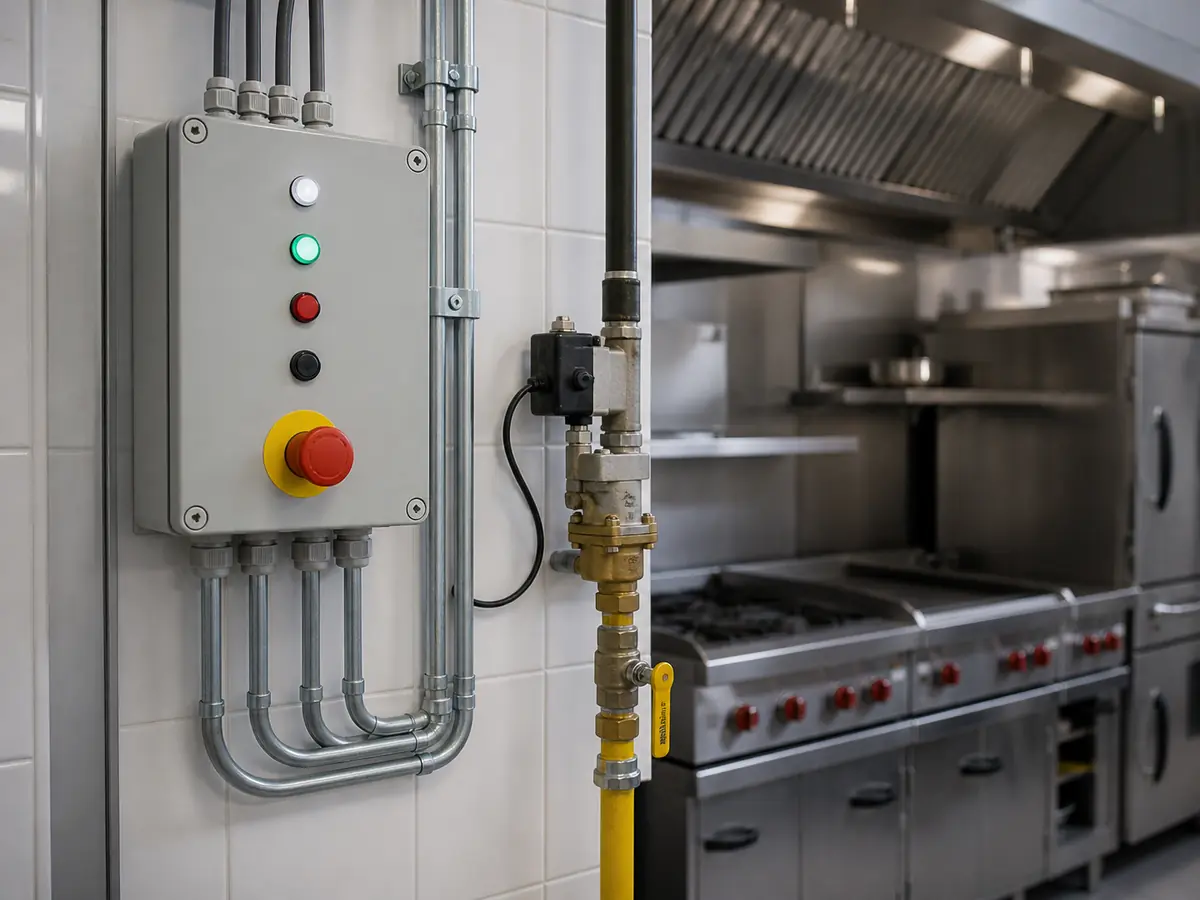
Most commercial kitchens with mechanical extraction should have the gas supply interlocked to the ventilation, so gas cannot flow to the appliances unless the extraction is running. It is one of the most important safety controls in the room, and the one most likely to be tampered with in winter when staff find the extraction cold or loud.
Test that switching off the extraction cuts the gas supply, and check that the reset procedure is understood on every shift. Never bypass or wedge an interlock. If yours trips often or your kitchen does not have one, our article on gas interlock systems in commercial kitchens explains how they work and what an installation involves.
Which appliance checks matter before the busy season?
Burners and safety devices take the most punishment in a busy kitchen, and the winter rush only adds to it. A short pre-season check by your engineer, alongside good daily cleaning, prevents most mid-service failures.
| Check | Why it matters in winter | Who |
|---|---|---|
| Burner ports clean and clear | Spill-overs block ports and cause poor flames under heavy use | Staff daily, engineer annually |
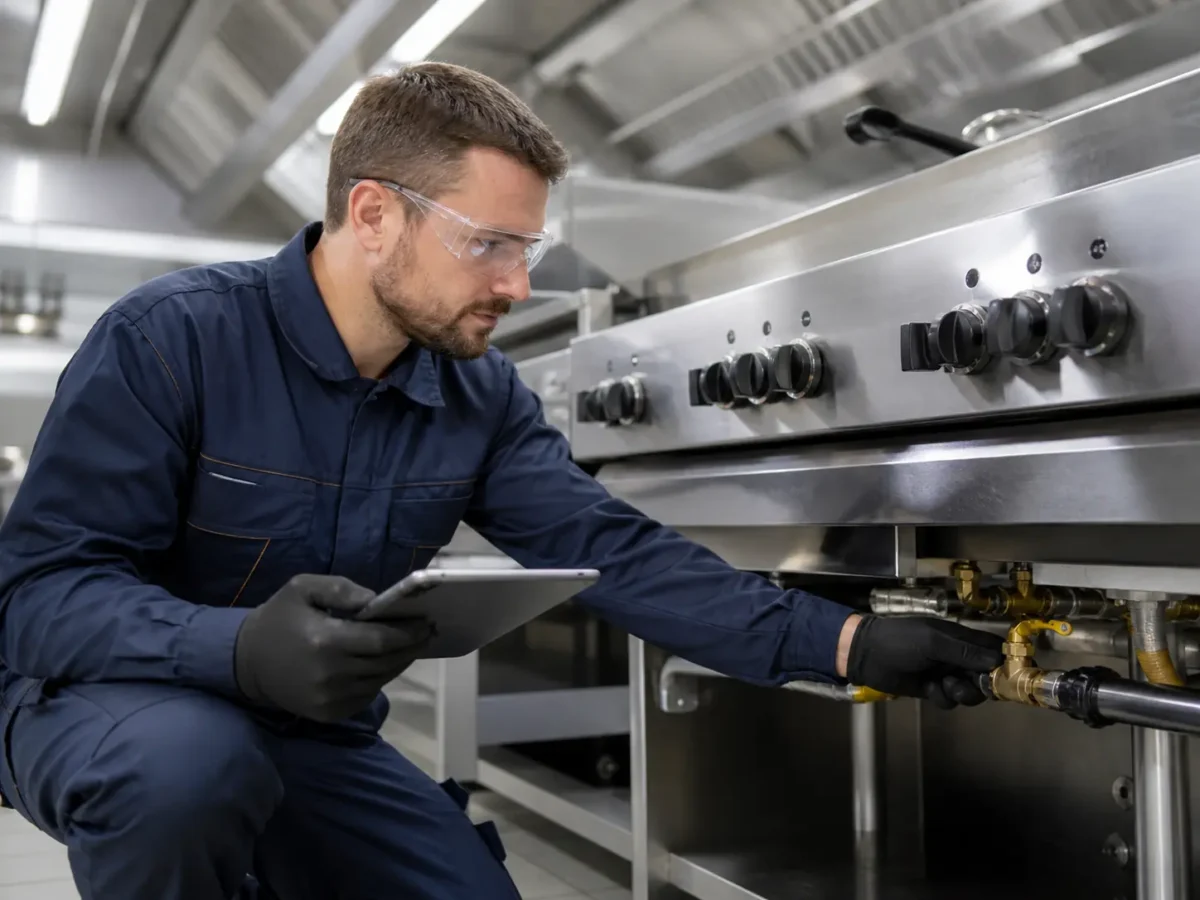
| Flame failure devices | Must shut off gas if a flame goes out | Gas Safe registered engineer |
| Flexible hoses and restraint cables | Moved appliances for deep cleans strain hoses | Staff visual, engineer test |
| Extraction and filters | Clears fumes when doors are closed | Staff and ventilation contractor |
| Emergency valve access | Extra Christmas stock often blocks it | Manager |
Never let staff attempt repairs to gas appliances, hoses or controls. Only a Gas Safe registered engineer with the right commercial catering qualifications may work on them, which you can verify on the Gas Safe Register.
Adding equipment for the Christmas trade?
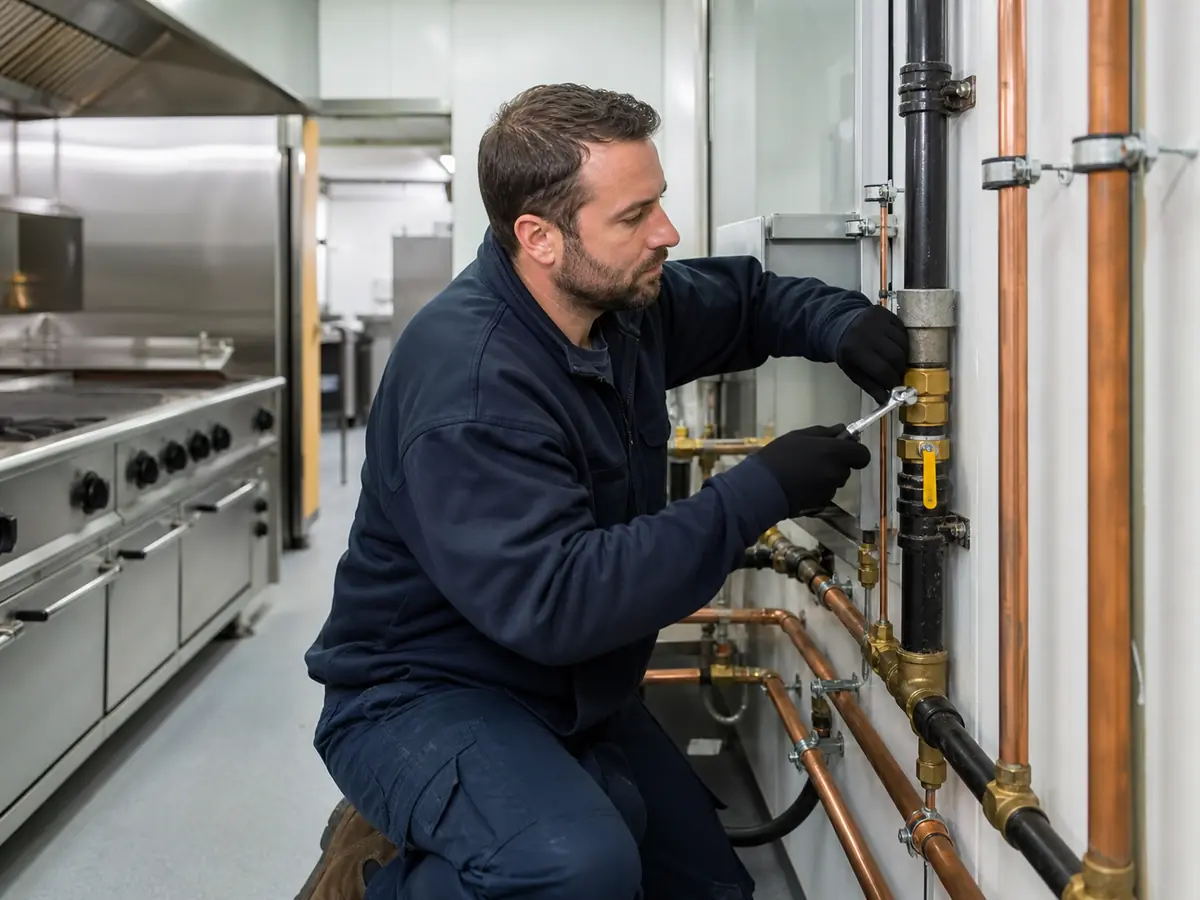
If you are bringing in an extra range, chargrill or fryer for the busy weeks, plan it now. Any new connection or extension to the gas pipework must be designed, installed and tested by a suitably qualified engineer, and the supply has to be sized for the extra load. Our commercial kitchen gas pipe installation team can check whether your existing supply will cope.
What should your emergency plan include?
Your emergency plan should tell any member of staff, including temporary seasonal workers, what to do in the first minute of a gas problem. Keep it on one sheet near the emergency control valve and go through it at the start of the season.
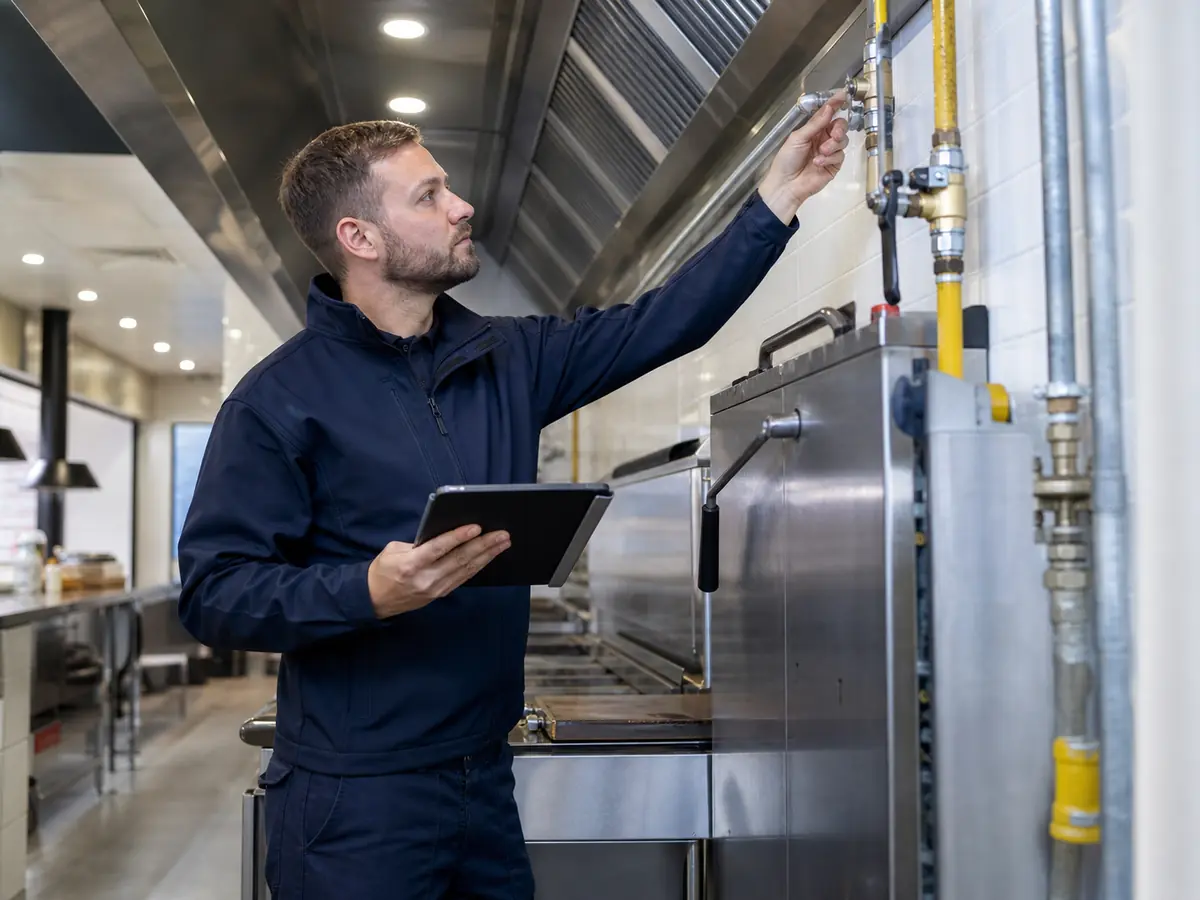
- Where the emergency control valve is and how to turn it off.
- Where the interlock or emergency stop button is and who can reset it.
- The National Gas Emergency Service number, 0800 111 999.
- Your gas engineer's contact details for faults that are not emergencies.
- Where the CP42 record and appliance manuals are kept.
Booking a pre-winter kitchen check in Stoke-on-Trent
We carry out CP42 gas safety inspections, interlock work and repairs for restaurants, cafes, takeaways and school kitchens across Stoke-on-Trent and Staffordshire. See our commercial catering gas engineer page for the full range of work, or call 07896 677083 to arrange a visit that fits around your service times.
Frequently asked questions
Can we keep cooking if the interlock keeps cutting out?
No. Repeated trips mean something is wrong, such as a failed fan, a blocked filter or a faulty sensor. Bypassing the interlock removes the protection against fumes building up in the kitchen. Stop using the gas appliances and get a Gas Safe registered engineer to find the cause.
Do mobile catering units need checking before winter too?
Yes. Food vans and trailers that work winter markets and events should have their gas installation inspected and recorded, commonly on a CP44 record. Cold weather adds its own issues, such as closed serving hatches reducing ventilation, so have the unit checked before the season starts.
Does a commercial kitchen need a carbon monoxide alarm?
Many kitchens fit CO detection as part of their risk assessment, and some installations use CO2 monitoring linked to the interlock. The right answer depends on your appliances and ventilation. Ask your engineer to assess it at your next inspection rather than relying on a domestic alarm.
Sources and further reading

Abdul runs Gasmaster Plumbing & Heating and has worked on boilers, heating and gas appliances across Stoke-on-Trent since 2005. He is Gas Safe registered (reg. 220932), and these articles come from his day to day work in homes and businesses across Staffordshire, Cheshire and Derbyshire.