On this page
- Is commercial boiler servicing a legal requirement?
- Which gas safety record does a business need?
- Who is allowed to service a commercial boiler?
- What does a commercial boiler service involve?
- How often should a commercial boiler be serviced?
- How can you plan servicing without disrupting the business?
- Booking commercial boiler servicing in Stoke-on-Trent
- Frequently asked questions
Quick answer
Businesses must keep gas appliances, pipework and flues at their workplace in a safe condition under the Gas Safety (Installation and Use) Regulations 1998. In practice that means servicing boilers at least as often as the manufacturer states, usually annually, by a Gas Safe registered engineer qualified for non-domestic work, with a written record kept.
Key takeaways
- Employers have a legal duty to maintain gas appliances at places of work.
- A commercial gas safety record differs from a landlord's CP12.
- Check the engineer's Gas Safe card lists non-domestic categories.
- Annual servicing is the norm; heavy-use plant may need more.
- Book summer servicing for heating plant to avoid winter downtime.
A boiler failing in a shop, office, salon or cafe is not just an inconvenience. It can mean closing early, sending staff home or turning customers away, and if the fault is a safety issue you may have a legal problem as well as a cold building. Here is what business owners and managers in Stoke-on-Trent and Staffordshire need to understand about keeping commercial gas heating serviced.
Is commercial boiler servicing a legal requirement?
The law requires the result rather than naming a service. Under the Gas Safety (Installation and Use) Regulations 1998, an employer or self-employed person must make sure gas appliances, pipework and flues at any place of work under their control are maintained in a safe condition. Regular servicing by a competent engineer is how you meet that duty.
The Health and Safety Executive's gas safety guidance sets out these duties in more detail. If you let commercial premises, check your lease: it should state who is responsible for the boiler, the pipework and the safety checks. Where a building includes living accommodation, such as a flat above a shop, the landlord duties for the residential part apply as well.
Which gas safety record does a business need?
It depends on what the gas is used for. A heating boiler in commercial premises is normally recorded on a non-domestic gas safety record, often called a CP17. Commercial kitchens need a catering record, the CP42. A landlord's CP12 covers residential lets, and mobile catering units have their own CP44.
| Record | Typically covers | Common examples |
|---|---|---|
| CP12 | Gas appliances in rented homes | Flats, houses, HMOs, flat above a shop |
| CP17 | Non-domestic gas appliances | Office, shop, salon or workshop heating |
| CP42 | Commercial catering appliances | Restaurant, takeaway, school or care home kitchen |
| CP44 | Mobile catering gas installations | Food vans, trailers, market stalls |
Many small businesses run on a domestic-sized wall-hung boiler. The boiler may be the same model found in a house, but because it is in a place of work it is recorded differently. For catering sites, our guide to CP42 vs CP12 explains the distinction in full.
Who is allowed to service a commercial boiler?
Only a Gas Safe registered engineer who holds the right non-domestic qualifications for that type of appliance. Registration alone is not enough: each engineer's Gas Safe ID card lists the categories of work they are qualified to carry out, and commercial heating and commercial catering are separate categories from domestic work.
Ask to see the card before work starts and check the back for the relevant non-domestic categories. You can also check any engineer on the Gas Safe Register website using their licence number. If a contractor cannot show the right categories, they should not be working on your plant.
What does a commercial boiler service involve?
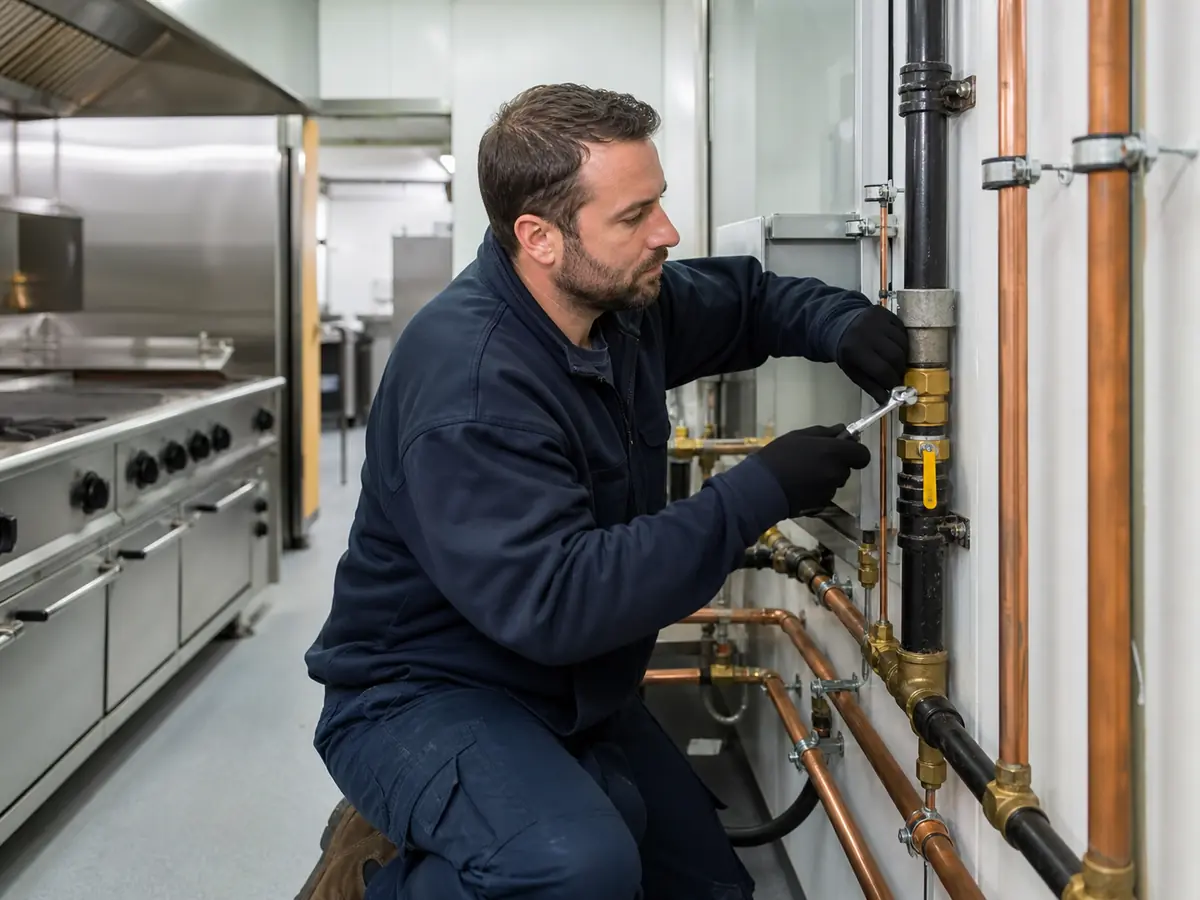
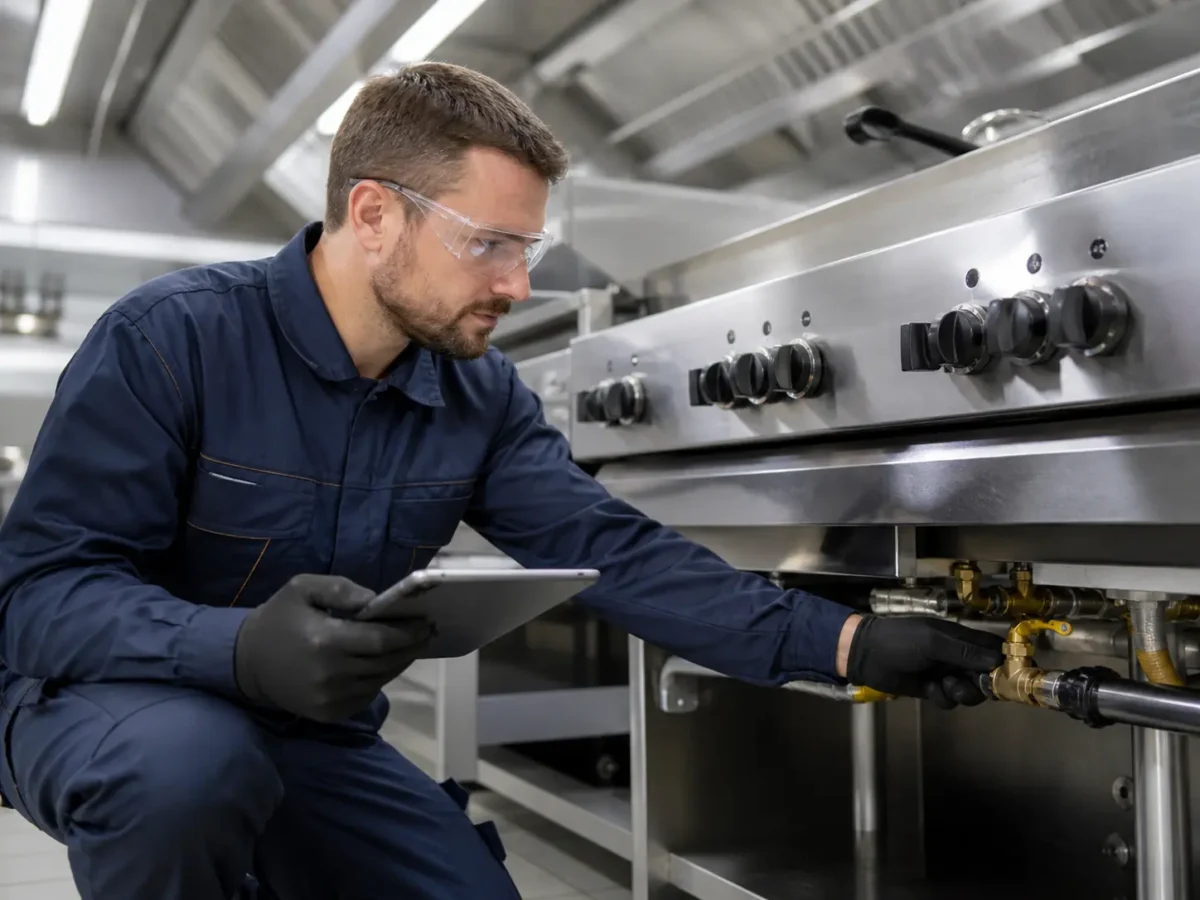
The core is similar to a domestic service: visual inspection, cleaning of the burner and heat exchanger where the manufacturer requires, checking seals and the flue, and testing combustion with a flue gas analyser. Commercial sites add checks that reflect how the building is used.
- Ventilation: plant rooms and enclosures need adequate air for combustion and cooling, and vents are often blocked by stored stock.
- Pipework: gas supply pipework, including any meter and valves, is tightness tested and inspected for corrosion and support.
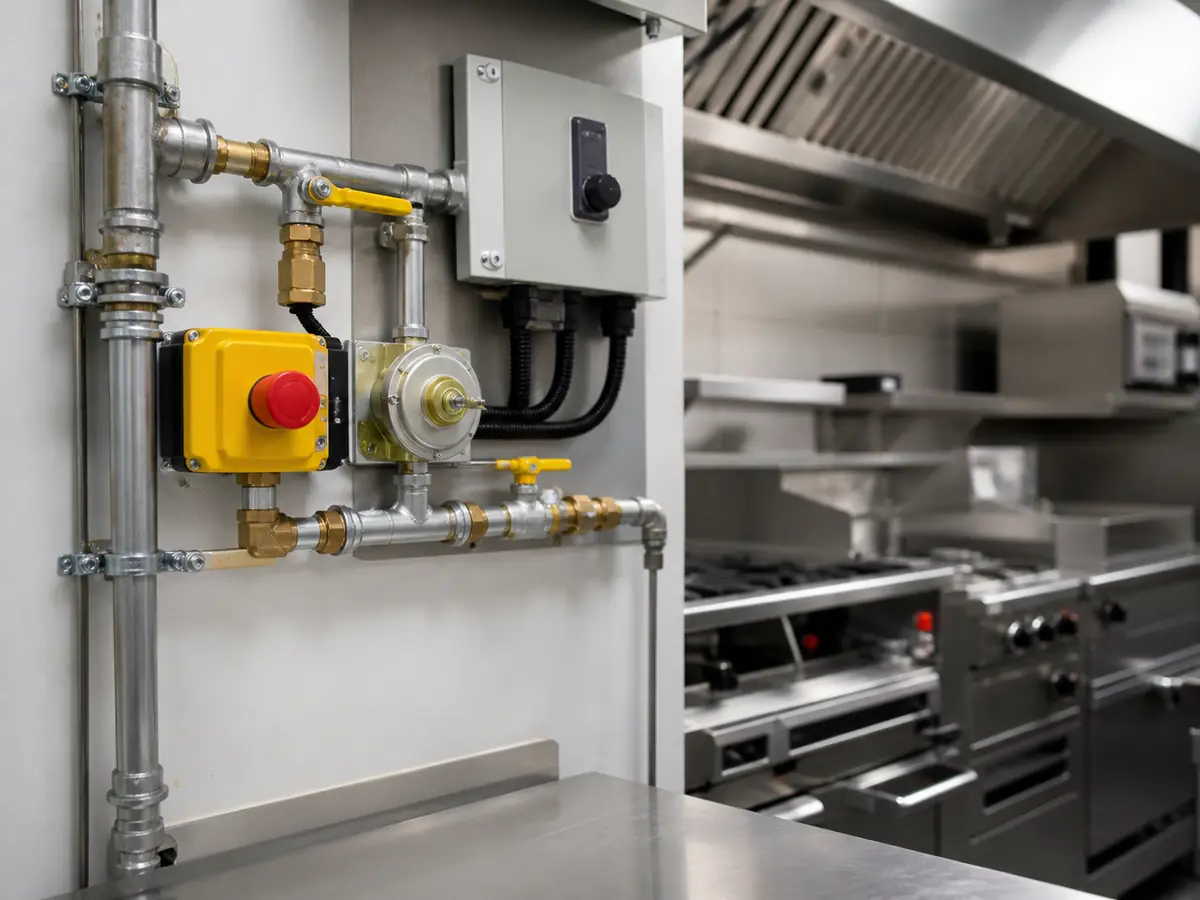
- Safety controls: flame supervision, pressure switches and any plant room shut-off valves are tested for correct operation.
- Flue route: longer or shared commercial flues are checked along their accessible length and at the terminal.
- Records: results are written up on the appropriate non-domestic record and the appliance log.
For a closer look at combustion testing, see what flue gas analysis is and why it matters.
How often should a commercial boiler be serviced?
At least annually is the standard, and always in line with the manufacturer's instructions. Plant that runs long hours, serves a large building or works in dusty or greasy conditions may need servicing more often. Your engineer should say so on the record if they believe the interval should be shorter.
Keep the records together, including any warning notices and repair invoices. They show an insurer, a landlord or an inspector that the duty to maintain has been taken seriously, and they help the next engineer see the history of the plant.
How can you plan servicing without disrupting the business?
Plan it for the quiet season. For heating plant, that means late spring or summer, when a few hours without heating costs nothing and any parts needed can be ordered without a cold building waiting on them. Catering equipment is a different case and is best done on your quietest trading day.
If you manage several sites, align the service dates so every record renews in the same month. It is far easier to track one date than six.
Booking commercial boiler servicing in Stoke-on-Trent
We are Gas Safe registered engineers working across Stoke-on-Trent, Staffordshire, south Cheshire and Derbyshire, with commercial catering, gas interlock and commercial pipework work alongside heating. For smaller premises with domestic-type boilers, our boiler service in Stoke-on-Trent is the place to start, and we also cover boiler service in Stafford and surrounding towns. Kitchens can be booked through our commercial catering gas engineer service.
Call 07896 677083 to talk through your premises and pick a date that suits your trading pattern.
Frequently asked questions
Can I use my home boiler engineer for my shop boiler?
Only if their Gas Safe ID card shows the non-domestic categories needed for that appliance. Many engineers are qualified for domestic work only. Check the back of the card or search their licence number on the Gas Safe Register before the visit.
Does a commercial gas safety record expire?
There is no fixed legal expiry date written into the regulations for workplaces, but the duty to maintain is ongoing and annual checks are the accepted standard. Insurers, landlords and local authorities commonly expect a record no more than twelve months old.
Who is responsible for the boiler in a rented shop or office?
It depends on the lease. Some leases make the tenant responsible for servicing and repairs, others leave it with the landlord. Read the repairing clauses, and if it is unclear, agree it in writing so the checks do not fall between the two parties.
What happens if the engineer finds the boiler unsafe?
They will follow the Gas Industry Unsafe Situations Procedure, explain the risk, and may turn off or disconnect the appliance with your permission if it is immediately dangerous. You will receive a warning notice explaining what needs fixing before it can be used again.
Sources and further reading

Gasmaster Plumbing & Heating has served Stoke-on-Trent since 2005. Every article is written by our Gas Safe registered engineers (reg. 220932) from day to day work on boilers, heating and gas appliances across Staffordshire, Cheshire and Derbyshire.