On this page
- What is flue gas analysis?
- What does a flue gas analyser measure?
- Why do the readings matter for safety?
- How do the readings affect efficiency?
- What happens if the readings are out of range?
- Is a boiler service without an analyser a real service?
- Booking a boiler service with full combustion analysis
- Frequently asked questions
Quick answer
Flue gas analysis is a test where a Gas Safe registered engineer puts an electronic analyser probe into the boiler's flue to measure the gases it produces. It reads oxygen and carbon monoxide and works out carbon dioxide and the CO/CO2 ratio. Those figures show whether the boiler is burning safely and efficiently, which cannot be judged by eye.
Key takeaways
- A flue gas analyser measures what the boiler is actually producing, not how it looks.
- The key readings are O2, CO, CO2 and the CO/CO2 ratio.
- Readings are compared with the manufacturer's figures for your specific boiler.
- Out-of-range readings mean investigation, and sometimes the boiler must be turned off.
- A service without combustion analysis is not a complete service.
On a modern condensing boiler you cannot see the flame, and even if you could, its colour tells you very little. The only reliable way to know whether a boiler is burning gas cleanly is to measure what comes out of the flue. That is the job of the flue gas analyser, and it is the heart of any proper service.
What is flue gas analysis?
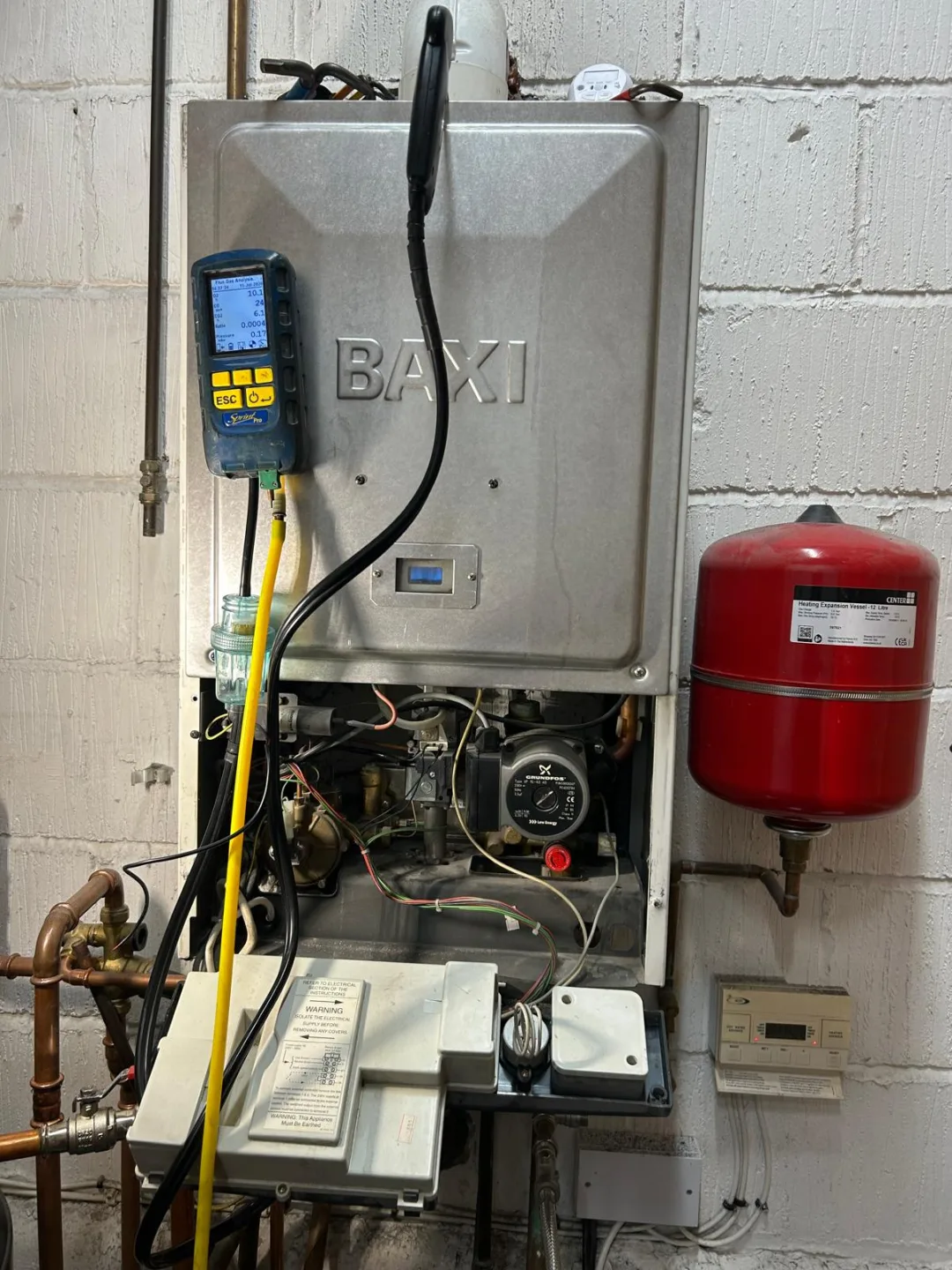
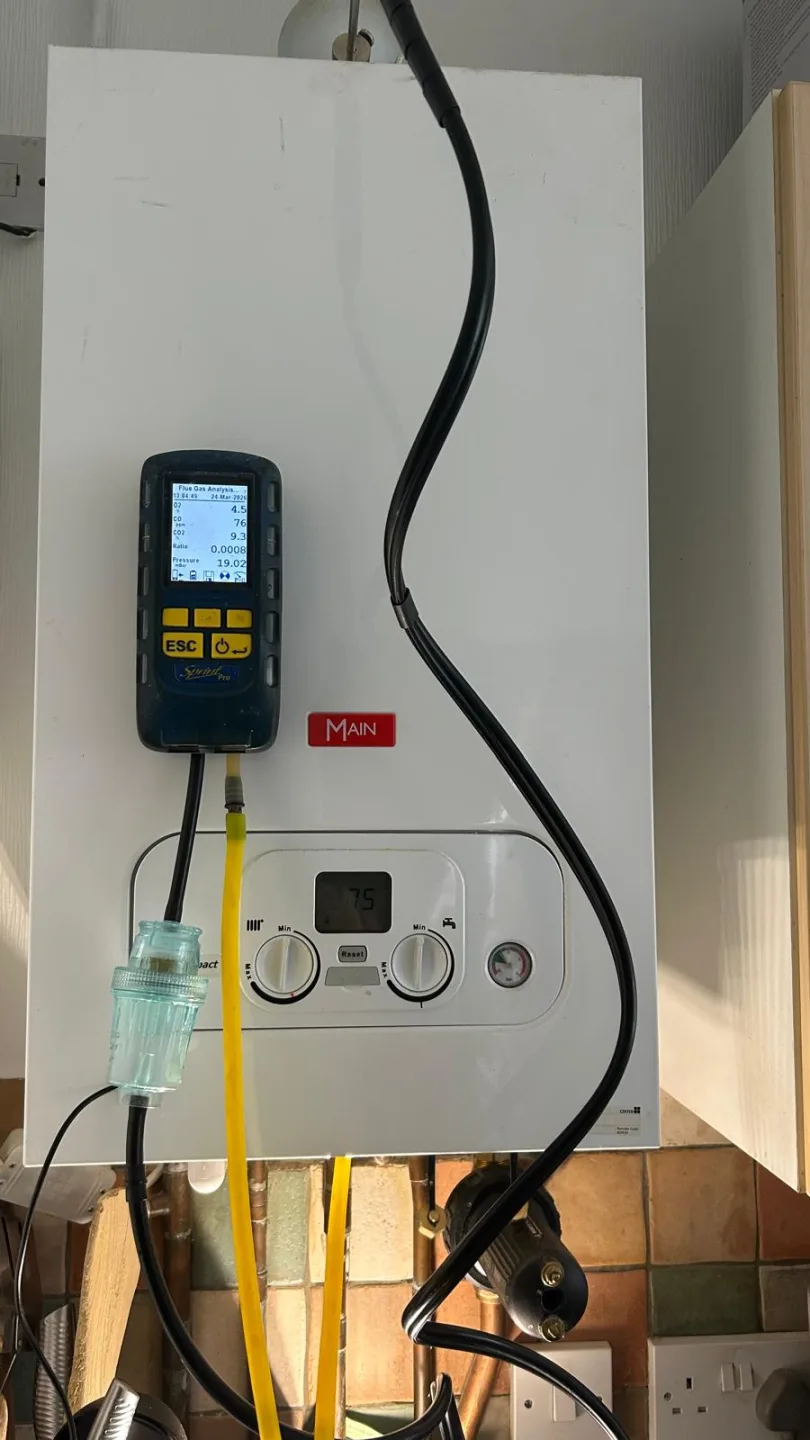
Flue gas analysis is a combustion test carried out with an electronic analyser. The engineer inserts a probe into a test point on the boiler's flue while it is running, and the analyser measures the gases being produced. The readings show whether the gas and air are mixing and burning correctly, and whether any carbon monoxide is being produced.
It is sometimes called combustion analysis, and the printout or screen readings are what should be written onto your service record. Industry guidance on using analysers is set out in British Standard BS 7967, and manufacturers publish the acceptable readings for each boiler model.
What does a flue gas analyser measure?
The analyser directly measures oxygen and carbon monoxide in the flue gases, plus flue and air temperature. From those it calculates carbon dioxide, the CO/CO2 ratio and an indicative efficiency figure. Each number tells the engineer something different about how the boiler is running.
| Reading | What it tells the engineer |
|---|---|
| O2 (oxygen) | How much excess air is passing through; too much or too little points to a set-up or air supply problem |
| CO (carbon monoxide) | Whether combustion is incomplete; this is the key safety reading |
| CO2 (carbon dioxide) | How rich or lean the burn is, compared with the manufacturer's range |
| CO/CO2 ratio | The overall quality of combustion, used to judge whether the boiler is safe to use |
| Flue temperature | Heat going to waste; unusually high readings can suggest a dirty heat exchanger |
Why do the readings matter for safety?
Carbon monoxide has no smell, colour or taste, and a boiler can produce it while appearing to work perfectly. The analyser detects CO in the flue before it becomes a risk in your home. The CO/CO2 ratio then tells the engineer whether combustion is within safe limits for that appliance.
On a room-sealed boiler with a concentric flue, the engineer can also sample the air intake. If flue gases are showing up where only fresh air should be, it points to a leaking flue joint or seal, which is a serious safety defect even if the boiler is burning well. Neither problem shows up from a look at the outside of the case. The HSE gas safety pages explain the risks of carbon monoxide in more detail.
How do the readings affect efficiency?
A boiler burning with the wrong mix of gas and air wastes fuel. Too much excess air carries heat out of the flue; too little leads to incomplete combustion and deposits on the heat exchanger. Getting the readings within the manufacturer's range means more of the gas you pay for goes into heating your home.
Comparing readings year on year is also useful. A slow drift in CO or flue temperature can show a heat exchanger gradually fouling or a component wearing, well before the boiler breaks down. It is one reason a service history is worth keeping, and it ties in with how boiler servicing boosts energy efficiency.
What happens if the readings are out of range?
The engineer investigates rather than simply noting it down. Common causes include a blocked or dirty heat exchanger, a damaged burner, a failing seal, a flue problem or a gas valve that needs setting up to the manufacturer's procedure. After the fault is put right, the boiler is retested to confirm the readings are back within range.
What happens next depends on how serious the readings are:
- Slightly out: cleaning or a minor adjustment to the manufacturer's instructions often brings them back.
- Needing parts: the engineer explains the fault and quotes for the part before fitting.
- Unsafe: if the readings show the boiler is not safe to use, the engineer follows the gas industry unsafe situations procedure. With your permission, the boiler is turned off and labelled until repaired.
A heat exchanger that needs a thorough clean is one of the more common findings on older boilers. We show what that involves in our write-up of heat exchanger cleaning in Longton.
Is a boiler service without an analyser a real service?
No. Without flue gas analysis, nobody can say whether the boiler is producing carbon monoxide or burning efficiently. Manufacturers expect combustion readings to be recorded at every service, and the Benchmark service record has space for them. A service record with no readings suggests the most important check was skipped.
The analyser must also be looked after properly. It should be zeroed in fresh air before each test and calibrated regularly in line with the manufacturer's recommendations. Our boiler service checklist shows where combustion analysis fits in the full service.
Booking a boiler service with full combustion analysis
Every annual boiler service in Stoke-on-Trent we carry out includes flue gas analysis, with the readings recorded for you. As the heating season eases into spring, it is a good time to check your boiler is burning cleanly before it sits quieter over summer.
We cover the south of the county too, including boiler service in Cannock and boiler service in Rugeley. Call 07896 677083 to book.
Frequently asked questions
Can I check my boiler for carbon monoxide myself?
Not in the way an engineer does. Flue gas analysis needs a calibrated analyser and access to the boiler's test points, which is work for a Gas Safe registered engineer. What you can do is fit an audible carbon monoxide alarm, test it regularly and watch for signs such as soot or staining around appliances.
Does a yellow flame mean my boiler is unsafe?
On an older boiler or gas fire with a visible flame, a lazy yellow or orange flame can indicate poor combustion and should be checked promptly. Most modern condensing boilers have no visible flame, which is exactly why analyser readings matter. If in doubt, turn the appliance off and get it checked.
Are the analyser readings the same for every boiler?
No. Acceptable ranges for CO2, CO and the CO/CO2 ratio are set by the manufacturer for each model, and can differ between maximum and minimum firing rates. That is why the engineer needs the boiler make and model, and ideally the manual, to judge the readings properly.
Sources and further reading

Gasmaster Plumbing & Heating has served Stoke-on-Trent since 2005. Every article is written by our Gas Safe registered engineers (reg. 220932) from day to day work on boilers, heating and gas appliances across Staffordshire, Cheshire and Derbyshire.