On this page
- What is a gas interlock system?
- Why do commercial kitchens need one?
- How does gas pressure proving work?
- How is the interlock tested during a CP42?
- What are the most common gas interlock faults?
- Is an interlock needed when you refit or extend a kitchen?
- Gas interlock installation and testing in Stoke-on-Trent
- Frequently asked questions
Quick answer
A gas interlock system links a commercial kitchen's gas supply to its mechanical extraction, so gas can only flow to the cooking appliances while the ventilation is proven to be running. If the fans stop or airflow fails, a solenoid valve shuts the gas off. BS 6173 expects one in mechanically ventilated catering kitchens.
Key takeaways
- An interlock stops gas flowing unless the extraction is running.
- Many systems also prove the pipework is sealed before gas is released.
- The interlock is tested as part of a CP42 catering gas safety check.
- Greasy sensors and slipping fan belts cause many nuisance shutdowns.
- A bypassed interlock is a serious safety defect, not a quick fix.
Every busy kitchen produces a lot of combustion products. Gas burners, griddles, fryers and ovens all burn fuel inside the room, and the canopy and extract fan are what carry those fumes away. If the fan fails and cooking carries on, carbon monoxide and other combustion products can build up where your staff are working. A gas interlock exists to stop that happening.
What is a gas interlock system?
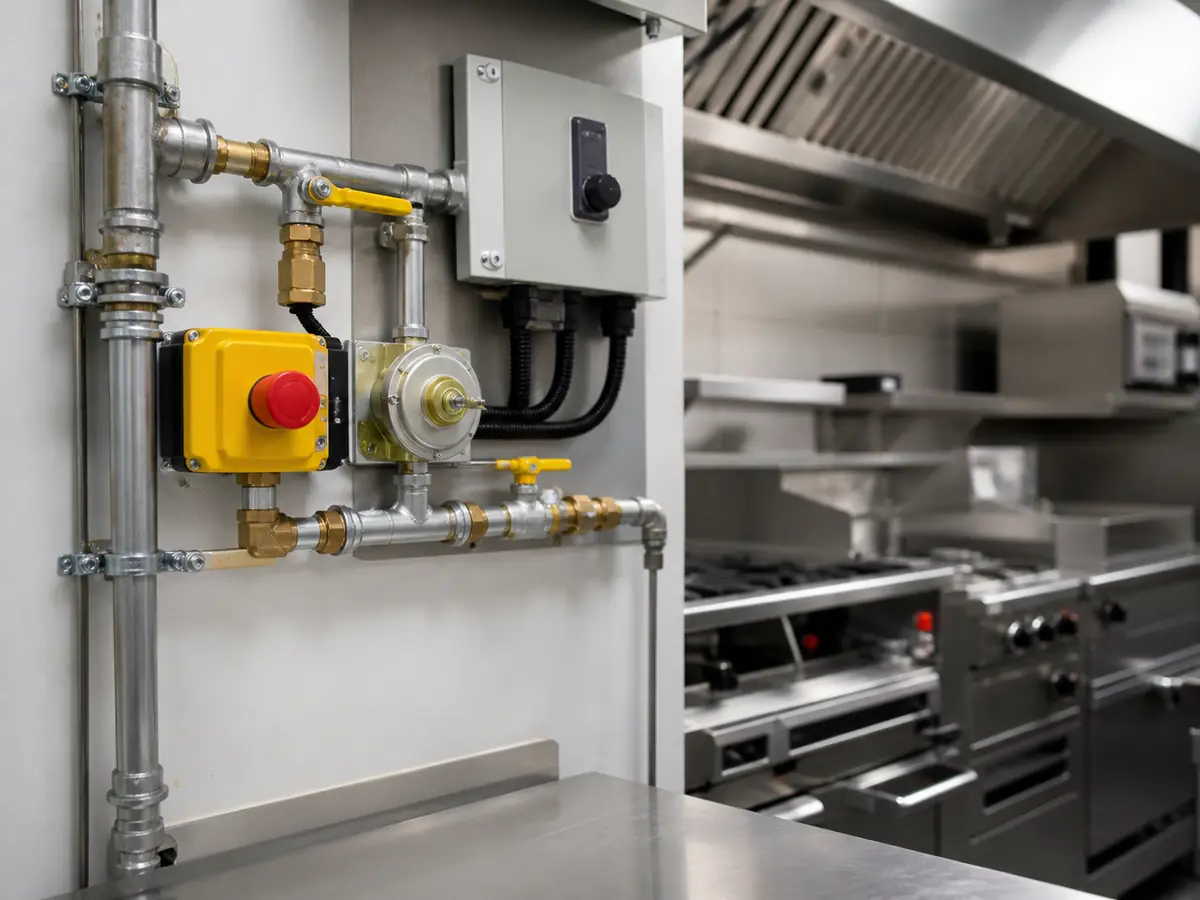
A gas interlock is a control system that only allows gas to reach the kitchen appliances while the mechanical ventilation is proven to be working. It uses sensors on the extraction, and on the supply air fan where there is one, to confirm airflow, then opens a solenoid valve on the gas supply. If the airflow is lost, the valve closes.
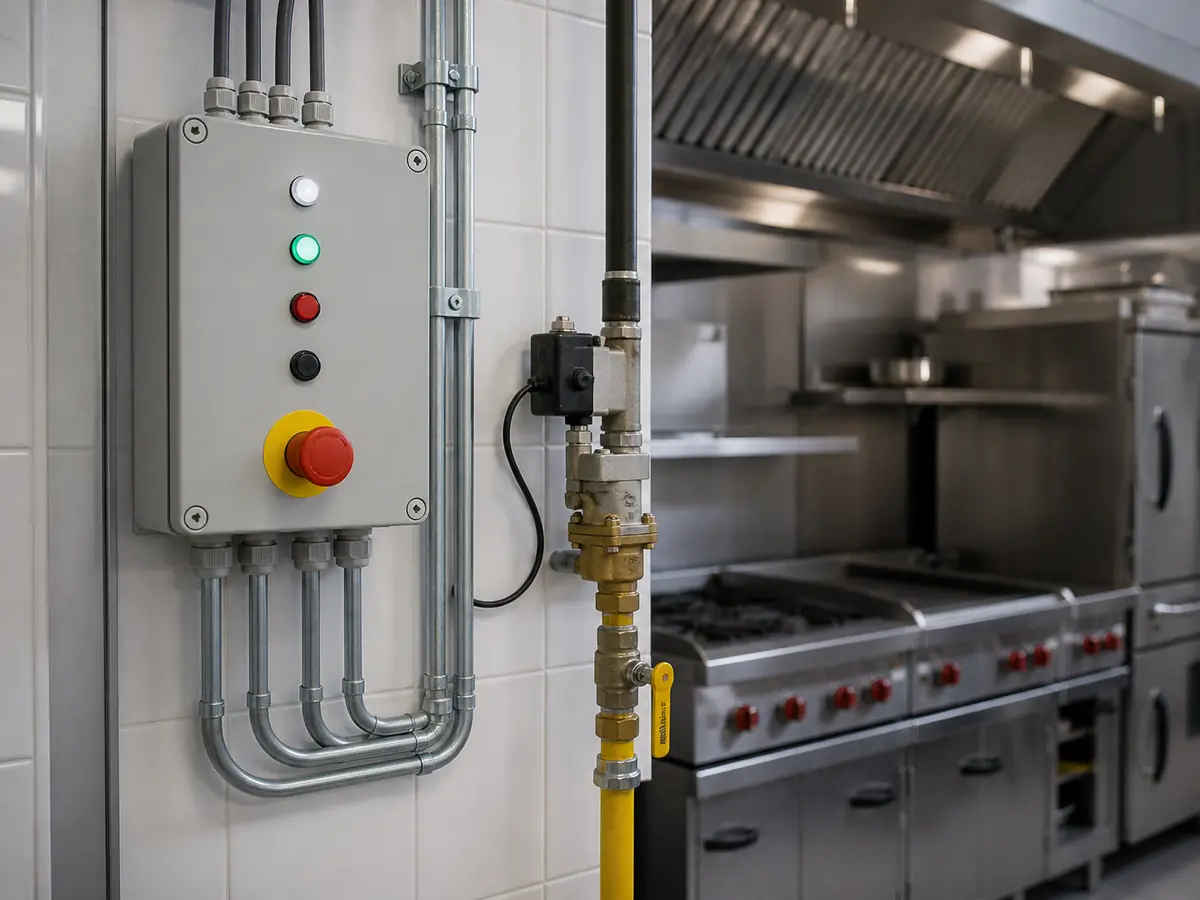
A typical system has a few main parts:
- Control panel: usually wall-mounted in the kitchen, with status lights and a reset or start button.
- Airflow proving: pressure differential switches on the ductwork, or current sensors on the fan motors, confirming the fans are genuinely moving air.
- Gas solenoid valve: an automatic valve on the kitchen gas supply that only opens when the panel allows it.
- Emergency stop: a clearly labelled knock-off button near the exit so staff can cut the gas instantly.
- Gas pressure proving (on many systems): a check that the pipework downstream holds pressure before the main valve opens.
Why do commercial kitchens need one?
They are needed because cooking appliances in a mechanically ventilated kitchen depend on that ventilation to remove combustion products safely. BS 6173, the British Standard for installing and maintaining gas catering appliances in commercial premises, expects the gas supply to be interlocked with the mechanical ventilation so appliances cannot run without it.
The duty behind it is broader. Employers must keep gas appliances and installations in the workplace safe under the Gas Safety (Installation and Use) Regulations 1998, and the Health and Safety Executive's gas safety pages set out what that means for catering businesses. A kitchen without an interlock where one is expected is likely to be flagged on inspection, particularly after a refit or when new appliances are added.
How does gas pressure proving work?
Pressure proving is a safety step that runs before gas is released into the kitchen. The system checks that the pipework and appliance valves downstream of the solenoid are sealed and holding pressure. If a burner tap has been left open, or there is a leak, the test fails and the gas stays off.
This matters because many older catering appliances, such as some open-top ranges and boiling tables, have burners without flame supervision. Without proving, a tap left open overnight would release unburnt gas the moment the system reset in the morning. When the panel refuses to start, the first thing to check is that every appliance tap and pilot is fully off.
How is the interlock tested during a CP42?
The interlock is tested functionally during a CP42 catering gas safety check. The engineer runs the extraction, confirms gas is available, then stops the fan or interrupts the airflow and checks the solenoid closes and gas is lost at the appliances. They also check the gas does not come back on by itself when the fan restarts.
Alongside this they test the emergency stop button, check proving works where fitted, and record the results. If the interlock does not work as designed, the kitchen cannot be passed as safe. Our guide on what a CP42 gas safety certificate is explains the rest of the inspection, and commercial boiler servicing covers the heating side of the same premises.
What are the most common gas interlock faults?
Most interlock problems are caused by the ventilation or the kitchen environment, not the gas side. Grease-laden air gets into the sensor tubes, fans lose performance, and staff press reset while burners are open. These faults are usually straightforward to find with a methodical check.
- Blocked or greasy sensor tubes on pressure switches, so the panel cannot see airflow.
- Slipping or worn fan belts, or clogged filters in the canopy, reducing airflow below the switch setting.
- Appliance taps left open, causing pressure proving to fail at start-up.
- Faulty solenoid valves that stick shut, or in rare cases fail to close.
- Power interruptions that drop the system out and need a manual reset.
Is an interlock needed when you refit or extend a kitchen?
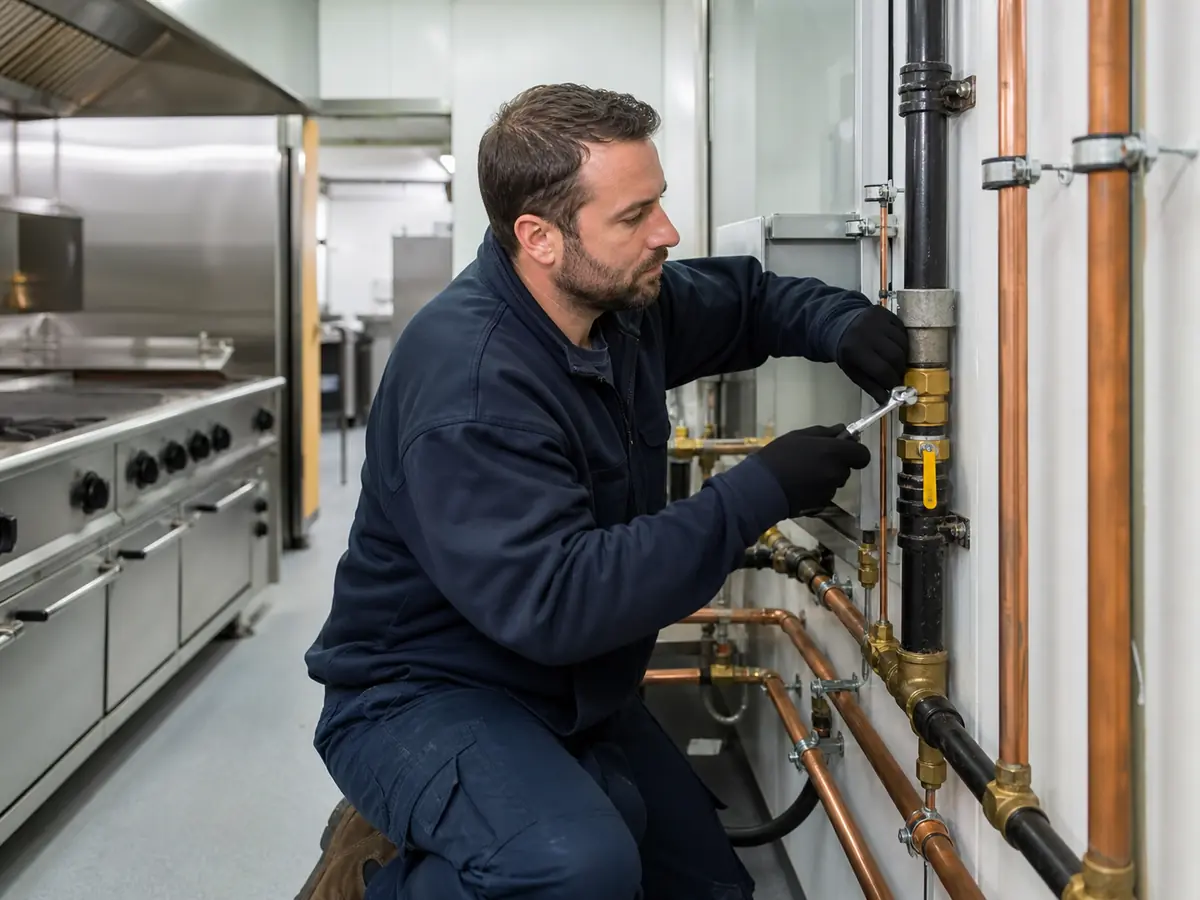
Usually, yes. Adding appliances, moving the canopy or altering the gas pipework is the point at which an installation is expected to meet current standards. New pipework, including the connection to the solenoid valve, should be sized for the new load, pressure tested and recorded before the kitchen goes back into use.
Plan the interlock at the same time as the extraction design rather than adding it at the end. Where the panel, sensors and solenoid are placed affects how reliably the system runs day to day.
Gas interlock installation and testing in Stoke-on-Trent
We install, test and repair gas interlocks for restaurants, takeaways, cafes, schools and care home kitchens across Stoke-on-Trent and Staffordshire. Interlock testing is included in our CP42 gas certificate inspections, and new or altered supplies are covered by our commercial kitchen gas pipe installation service.
If your panel keeps tripping, or you are planning a refit, call 07896 677083 and we can arrange a visit at a time that works around service.
Frequently asked questions
Can I reset a gas interlock myself?
Yes, following the panel instructions: make sure the extraction is running and every appliance tap and pilot is off, then press reset or start. If it will not reset, or trips repeatedly, do not keep trying. Call a Gas Safe registered engineer with commercial catering qualifications to find the cause.
Does a gas interlock stop carbon monoxide?
It does not detect carbon monoxide directly. It prevents appliances running without the ventilation that removes combustion products. Some kitchens also fit CO detection as an extra layer. Keeping extraction, filters and canopies clean is still essential.
Do small cafes with a domestic cooker need an interlock?
It depends on the appliances and how the kitchen is ventilated. The requirement applies to mechanically ventilated commercial catering installations. A Gas Safe engineer with catering qualifications can assess your setup and tell you what applies to your premises.
Sources and further reading

Gasmaster Plumbing & Heating has served Stoke-on-Trent since 2005. Every article is written by our Gas Safe registered engineers (reg. 220932) from day to day work on boilers, heating and gas appliances across Staffordshire, Cheshire and Derbyshire.