On this page
Quick answer
A gas tightness test checks that a gas installation’s pipework and fittings are not leaking. The engineer isolates the supply, pressurises the pipework and monitors a pressure gauge over a set period; any drop beyond allowed limits indicates a leak. Tightness tests are carried out when new pipework is installed, after work on existing pipework, when a gas supply is turned back on, when a gas smell is reported, and as part of commercial safety checks. Domestic tests follow IGEM/UP/1B; commercial and larger installations follow IGEM/UP/1 or 1A.
Key takeaways
- A tightness test confirms pipework and fittings are sound and not leaking.
- It is required after new gas work, after work on pipework and when reinstating supply.
- It is a standard part of investigating a reported gas smell.
- Domestic installations use IGEM/UP/1B; commercial installations use IGEM/UP/1 or UP/1A.
- If a test fails, the leak must be found and fixed before the supply is used.
How a tightness test works
- The engineer turns off appliances and isolates the supply at the meter.
- A calibrated pressure gauge is connected, often at the meter test point.
- The installation is brought to the test pressure.
- After a stabilisation period, the engineer monitors the gauge for a set time.
- Any drop is compared with the permissible limit for that installation size and meter type.
- If it passes, appliances are reconnected, purged and checked.
On larger commercial installations, the calculation of test duration and permitted pressure drop depends on pipework volume, which is why commercial tests take longer and follow different standards.
When a tightness test is required
- New gas installations or extensions to pipework.
- After any work that breaks into pipework, such as fitting a new boiler or hob.
- When the gas supply is turned back on after being off.
- When investigating a gas smell or suspected leak.
- As part of commercial gas safety inspections and before issuing a CP42 or similar record. See commercial boiler servicing.
Commercial kitchens and plant rooms
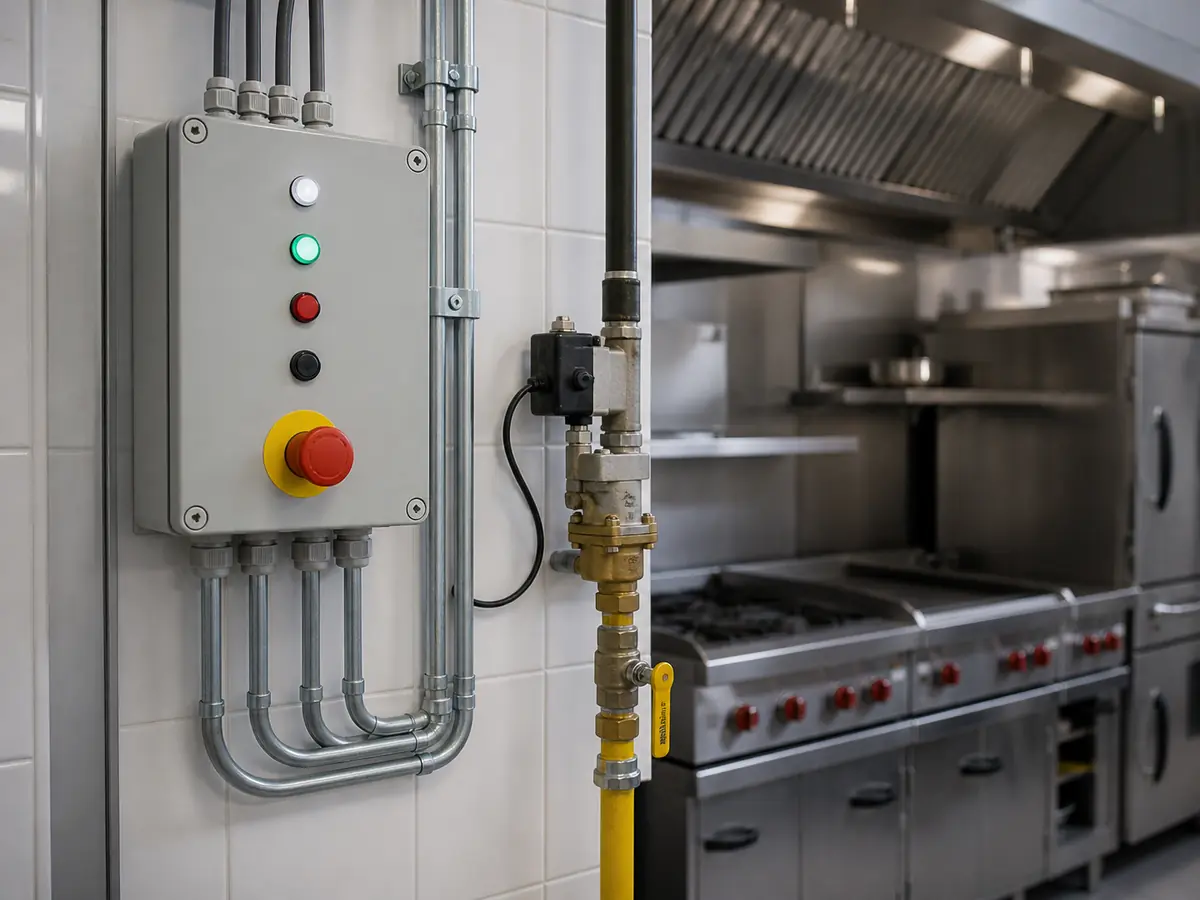
Commercial catering and plant rooms often have extensive pipework, multiple appliances and safety interlocks. Tightness testing is part of confirming the installation is safe. See gas interlock systems explained and CP42 gas certificates.
If the test fails
The engineer will trace the leak using leak detection fluid, electronic detectors and by isolating sections. The supply will not be left on if there is an unsafe leak. Repairs must be completed and a retest passed.
If you smell gas
Turn off the supply at the meter, open doors and windows, do not operate electrical switches, and call the National Gas Emergency number on 0800 111 999. See gas smell: what to do.
Book with Gasmaster
Need a tightness test on a domestic or commercial installation? Gasmaster Plumbing & Heating, Gas Safe registered (220932), works across Stoke-on-Trent, Newcastle-under-Lyme and Biddulph. See our Gas Safe engineers.
Frequently asked questions
How long does a gas tightness test take?
A domestic test often takes minutes once set up. Commercial tests take longer depending on pipework volume.
Does a boiler service include a tightness test?
Not always. A tightness test is carried out when work breaks into pipework or where there is reason to suspect a leak.
Can a tightness test damage pipework?
No. Test pressures are set to safe levels for the installation.
Sources
- IGEM/UP/1B, tightness testing of domestic installations (igem.org.uk)
- IGEM/UP/1 and UP/1A, commercial installations (igem.org.uk)
- Health and Safety Executive, gas safety guidance (hse.gov.uk)
Related services

Abdul runs Gasmaster Plumbing & Heating and has worked on boilers, heating and gas appliances across Stoke-on-Trent since 2005. He is Gas Safe registered (reg. 220932), and these articles come from his day to day work in homes and businesses across Staffordshire, Cheshire and Derbyshire.