On this page
- Why does boiler pressure drop when it is cold?
- What is a normal boiler pressure in winter?
- How does the expansion vessel affect pressure?
- What is the pressure relief valve and why does it drip?
- Could it be a leak I cannot see?
- When should I top up the pressure myself?
- Getting pressure problems fixed before winter
- Frequently asked questions
Quick answer
Boiler pressure changes with temperature: water expands when hot and contracts when cold, so the gauge reads higher with the heating on and lower when it is off. A small, steady swing is normal. Pressure that keeps falling in winter usually means a leak, a flat expansion vessel or a pressure relief valve letting water out.
Key takeaways
- Pressure rises as the system heats and falls as it cools; that swing is normal.
- Always read the gauge cold and compare with the manual's recommended range.
- A big swing plus regular top-ups often points to the expansion vessel.
- A dripping pipe outside by the boiler usually means the relief valve is opening.
Water expands as it heats up and shrinks as it cools. A sealed central heating system is a closed loop of water, so that expansion and contraction shows up directly on the boiler pressure gauge. Understanding what is normal makes it much easier to spot the point where a dropping gauge becomes a fault worth fixing before the heating is running every day.
Why does boiler pressure drop when it is cold?
Mostly because the water in the system is cooler. When the heating switches off overnight, the water contracts and the gauge reading falls. On a cold morning, before the boiler has fired, you are seeing the system at its lowest. That is expected. What matters is whether the reading returns to the same level each day or keeps sliding lower.
Winter also puts the system under more strain. The heating runs longer and hotter, so the water goes through bigger temperature swings every day. Any weakness that stayed hidden in summer, when a combi was only heating water for taps, gets tested harder in December. That is why a pressure problem often seems to appear with the first spell of cold weather.
What is a normal boiler pressure in winter?
For most combi and system boilers, a cold reading of roughly 1 to 1.5 bar is typical, rising to somewhere around 1.5 to 2 bar with the heating fully warmed up. The exact figures depend on the boiler and the height of your home, so check the recommended range in your manual. Take your reference reading with the system cold.
| What you see | Likely meaning |
|---|---|
| Rises a little when hot, returns to the same level when cold | Normal expansion and contraction |
| Rises sharply when hot, well above the normal range | Expansion vessel may have lost its air charge |
| Rises close to 3 bar, then drops low once cool | Pressure relief valve likely discharging water |
| Falls a little lower every few days, heating on or off | A leak somewhere in the system |
| Dropped once, straight after bleeding radiators | Normal; air replaced by water lowers pressure |
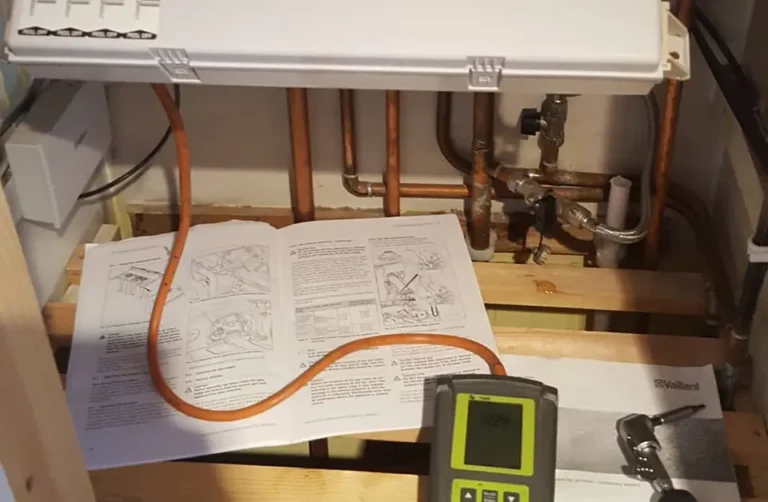
Manufacturers such as Vaillant set out the recommended operating pressure for each model in the user manual, so use that rather than a general figure if the two differ.
How does the expansion vessel affect pressure?
The expansion vessel is a small tank, usually inside the boiler casing on a combi, that absorbs the extra volume of water as the system heats. Inside is a flexible diaphragm with air on one side. If that air charge leaks away over time, there is nowhere for the expanding water to go, so the pressure shoots up whenever the heating runs.
That sets off a frustrating cycle. The pressure climbs too high, the relief valve opens to protect the system and lets water out, and when the system cools the pressure drops lower than before. You top it up, and it happens again. Recharging or replacing an expansion vessel is a job for a Gas Safe registered engineer, as it usually means working inside the boiler. Never remove the casing yourself.
What is the pressure relief valve and why does it drip?
The pressure relief valve is a safety device that opens at around 3 bar to stop the system over-pressurising. It discharges through a small copper pipe that usually runs through the wall near the boiler. If you see that pipe dripping or a wet patch beneath it, the valve has been opening, or it is no longer sealing properly.
A valve that opens now and then is a symptom, usually of a flat expansion vessel or overfilling. A valve that drips constantly, even at normal pressure, may have debris on its seat or be worn, and will need replacing. Both are worth sorting before winter, because the heating works hardest just when the problem is at its worst.
Could it be a leak I cannot see?
Yes. Small leaks do not always leave a puddle. Water can escape from a weeping radiator valve, a joint under the floorboards or a component inside the boiler and simply evaporate from warm pipework. Winter shows these leaks up because hotter water and bigger swings stress joints more than a summer of hot water only.
Things you can check yourself without opening the boiler:
- Look under each radiator valve and around towel rails for staining, rust or a white crust of dried deposits.
- Check the pipes under the boiler and inside the cupboard for damp or drips.
- Look for the relief valve discharge pipe outside and see if it is wet.
- Check ceilings below bathrooms and upstairs radiators for new stains.
- Note how often you top up the pressure and by how much.
Our existing post on why your boiler keeps losing pressure goes through the leak side in more depth.
When should I top up the pressure myself?
If the gauge is below the recommended cold range, you can top it up through the filling loop, following the manufacturer's manual, with the system cold. Fill slowly, stop within the range, and close both valves fully afterwards. Our guide on how to repressurise a combi boiler walks through it.
Tip: Keep a note on your phone each time you top up, with the date and the reading before and after. Needing a top-up once or twice a year is usually nothing to worry about. Needing one every week or two is a fault, and the notes help an engineer find it faster.
Overfilling is a common mistake that causes its own problems, because it pushes the relief valve to open once the system gets hot. If you have just run the heating for the first time since spring, as we suggest in our post on testing your heating before winter, give the system time to cool before you judge the reading.
Getting pressure problems fixed before winter
If you are topping up regularly, or the relief pipe outside is dripping, it is better to get it looked at now than in a cold snap. A boiler repair visit is £90 per hour, and our engineers check the expansion vessel charge, relief valve and visible pipework as a matter of course.
We cover south Cheshire as well as Staffordshire, including boiler service in Crewe and boiler service in Nantwich. Call 07896 677083 and let us know how often you have been topping up.
Frequently asked questions
Is it dangerous if my boiler pressure is too high?
The pressure relief valve is there to stop dangerous pressure by releasing water at around 3 bar. High pressure is not usually an immediate danger, but it means something is wrong. Turn the heating off, let it cool and call an engineer if it stays high.
Why does my pressure drop overnight but recover in the morning?
As the heating switches off, the water cools and contracts, so the reading falls. When the heating fires again the water expands and the pressure rises. If it returns to the same level each time, that is normal behaviour.
Will low pressure stop my boiler working?
Yes. Most modern boilers have a low pressure sensor and will lock out if the pressure falls too far, stopping both heating and hot water on a combi. Topping up to the correct level and resetting usually restores it.
Does adding inhibitor to the system affect boiler pressure?
Inhibitor protects the inside of the system against corrosion and sludge, and does not change pressure behaviour in a noticeable way. If an engineer adds or tops up inhibitor, they will leave the system at the correct pressure afterwards.
Sources and further reading

Gasmaster Plumbing & Heating has served Stoke-on-Trent since 2005. Every article is written by our Gas Safe registered engineers (reg. 220932) from day to day work on boilers, heating and gas appliances across Staffordshire, Cheshire and Derbyshire.