On this page
- What should be on a winter boiler checklist?
- Step 1: when should I book my boiler service?
- Steps 2 to 4: how do I check pressure and radiators?
- Step 5: does my condensate pipe need insulating?
- Step 6: is my carbon monoxide alarm working?
- Steps 7 to 9: are your controls and emergency plans ready?
- Getting your boiler winter-ready in Stoke-on-Trent
- Frequently asked questions
Quick answer
A winter boiler checklist should cover: booking an annual service, checking the pressure gauge, bleeding radiators, running the heating before it turns cold, insulating an external condensate pipe, testing your carbon monoxide alarm, setting timers and thermostats, finding your stopcock and saving emergency numbers. Most of it takes an afternoon.
Key takeaways
- Book the service first, while engineers still have plenty of availability.
- Check pressure and bleed radiators with the system cold.
- Insulate any external condensate pipe before the first frost.
- Test the CO alarm and save 0800 111 999 in your phone.
Winter problems with boilers rarely come out of nowhere. Most start as something small in late summer: a radiator that is cool at the top, pressure that creeps down, a condensate pipe running bare along an outside wall. Work through this list over the next few weeks and you will head into the colder months knowing your heating is ready.
What should be on a winter boiler checklist?
A good winter checklist covers the boiler, the heating system around it and what you would do if something went wrong. Some items need a Gas Safe registered engineer, but most are quick checks any householder can do safely. Here are the nine steps, in the order we would tackle them.
- Book your annual boiler service.
- Check the boiler pressure gauge.
- Bleed any radiators that are cold at the top.
- Run the heating for a test before you need it.
- Insulate an external condensate pipe.
- Test your carbon monoxide alarm.
- Set the timer, room thermostat and radiator valves for winter.
- Find and test your stopcock.
- Save emergency and engineer numbers in your phone.
Step 1: when should I book my boiler service?
Book it now, for August or early September. Engineers are far busier once the first cold snap arrives, and a summer service leaves time to order and fit parts if something needs replacing. If your service is not due until the winter, bringing it forward a couple of months does no harm.
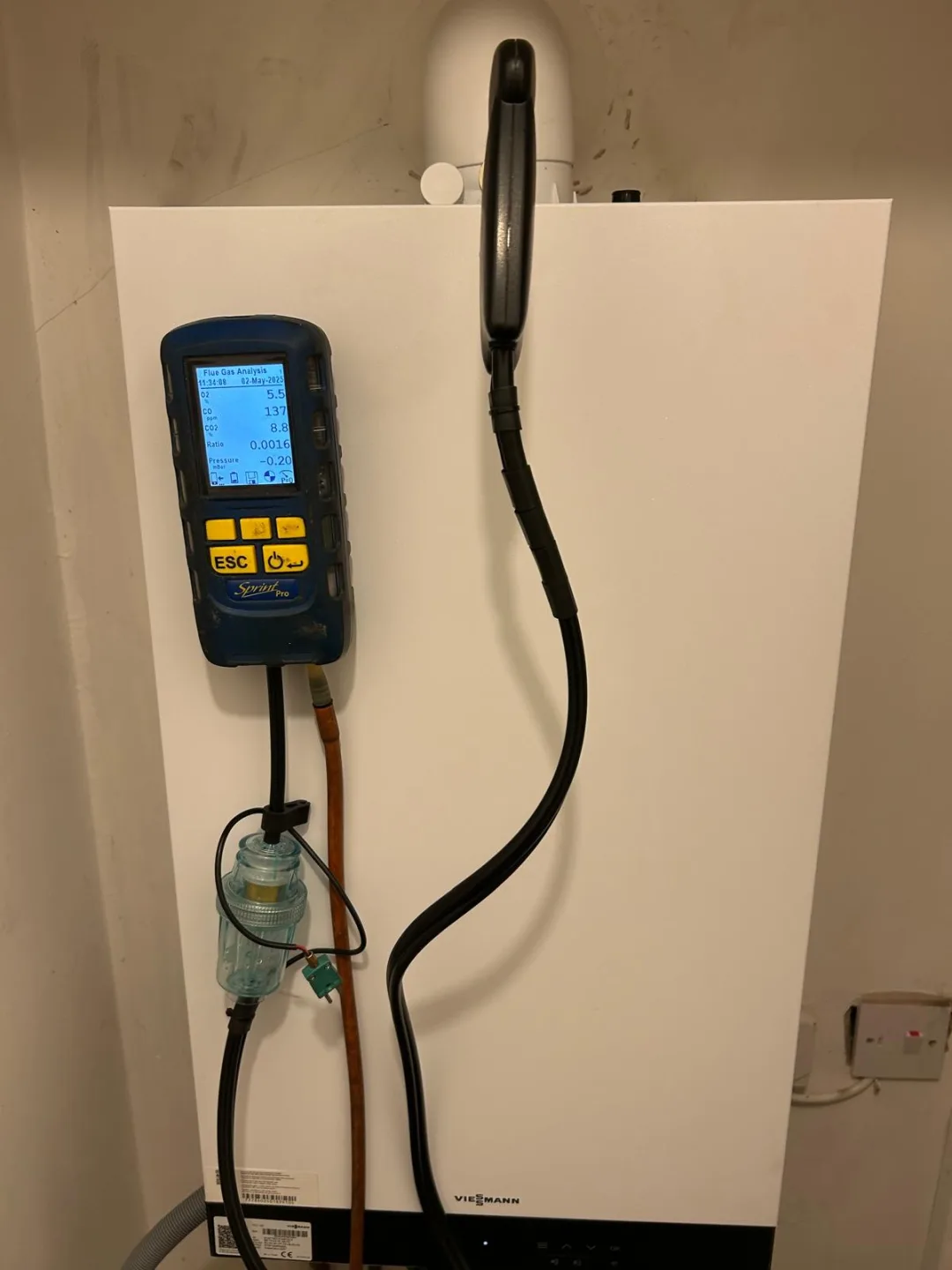
A standard boiler service in Stoke-on-Trent is £90 and typically takes 45 to 60 minutes. The engineer checks the burner, heat exchanger, seals, flue, gas pressure and combustion, and clears the condensate trap. That last job matters a lot in winter, because a partly blocked trap is a common cause of lockouts on cold nights.
Steps 2 to 4: how do I check pressure and radiators?
Check the pressure gauge with the heating off and the system cold. On most combi and system boilers it should read roughly 1 to 1.5 bar cold, but your manual gives the exact figure. If it is low, you can top it up through the filling loop following the manufacturer's instructions, and note how quickly it drops again.
Our step-by-step guide on how to repressurise a combi boiler walks through this. If you need to top up more than a couple of times a year, mention it at your service, as it usually points to a small leak or an expansion vessel problem.
Next, run the heating for half an hour and feel each radiator. Cold at the top means trapped air, which you can release by bleeding it. Cold at the bottom usually means sludge, which bleeding will not fix. Bleeding lowers the system pressure, so check the gauge again afterwards. Running the heating now, in late summer, also tells you whether the pump and valves have come through the summer without sticking.
Step 5: does my condensate pipe need insulating?
If your boiler is a condensing model, and almost every boiler fitted in recent years is, look for a thin plastic pipe running from the boiler to a drain. If any part of it runs outside, it can freeze in a hard frost and shut the boiler down. Insulating it is one of the cheapest winter jobs you can do.
Use waterproof, weather-resistant pipe insulation from a builders merchant, and cover the whole external run including bends and the open end area. If the external pipe is narrow, very long or runs with little fall, ask the engineer about upsizing or rerouting it during your service. Rerouting is engineer work, not a DIY job.
Step 6: is my carbon monoxide alarm working?
Press the test button and listen for the alarm. Then check the end-of-life date printed on the back, because CO alarms do not last forever. Fit one in any room with a fuel-burning appliance, and follow the manufacturer's guidance on height and distance from the boiler. The Gas Safe Register also lists the warning signs of carbon monoxide to watch for.
If your CO alarm sounds: turn off gas appliances if it is safe to do so, open doors and windows, get everyone outside and call the National Gas Emergency Service on 0800 111 999. Do not use the appliance again until a Gas Safe registered engineer has checked it. Never remove the boiler casing yourself.
Landlords in England have specific legal duties here. Our post on carbon monoxide alarms and your boiler covers what the rules require.
Steps 7 to 9: are your controls and emergency plans ready?
Set your timer for winter hours and check the clock is right, especially after any power cut. Replace the batteries in a wireless room thermostat before they die on a frosty morning. Turn radiator valves up to check they move freely, since the pins in thermostatic valves can stick after months closed.
Then find your stopcock and make sure it turns. Our guide to finding and testing your stopcock explains how. Finally, save these numbers in your phone and on a note near the boiler:
- National Gas Emergency Service: 0800 111 999, for a gas smell or suspected carbon monoxide.
- Your water supplier's emergency line.
- A local Gas Safe registered engineer, together with your boiler make, model and last service date.
Getting your boiler winter-ready in Stoke-on-Trent
The most important item on the list is the first one. If your boiler has not been serviced in the last 12 months, book it before the rush and let the engineer pick up anything you have spotted while working through the rest of this checklist. You can also read our earlier advice on avoiding boiler breakdowns this winter.
We cover the whole of Stoke-on-Trent and nearby, including boiler service in Trentham and boiler service in Blythe Bridge. Call 07896 677083 to book a date that suits you.
Frequently asked questions
Can I do a winter boiler check myself instead of a service?
You can safely check pressure, bleed radiators, test controls and insulate a condensate pipe. You cannot open the boiler, check combustion or clean internal parts; that must be done by a Gas Safe registered engineer during a service.
What temperature should my boiler be set to in winter?
It depends on the boiler, your radiators and how well insulated the home is. Many condensing boilers run more efficiently at a lower heating flow temperature than the factory setting. Ask your engineer to suggest a setting at the next service.
Should I leave my boiler on frost protection when I go away in winter?
Yes, or leave the heating on a low setting. A boiler's built-in frost protection mainly protects the boiler itself, so in very cold spells a low room temperature gives better protection to pipes elsewhere in the house.
How do I know if my boiler is condensing?
Most gas boilers fitted in England since 2005 are condensing models. A visible white plastic condensate pipe leading from the boiler to a drain is the easiest sign. Your manual or the data label will also say.
Sources and further reading

Gasmaster Plumbing & Heating has served Stoke-on-Trent since 2005. Every article is written by our Gas Safe registered engineers (reg. 220932) from day to day work on boilers, heating and gas appliances across Staffordshire, Cheshire and Derbyshire.