On this page
- Why does a gas boiler produce carbon monoxide?
- What are the symptoms of carbon monoxide poisoning?
- Where should you fit a carbon monoxide alarm?
- How do you test and look after a CO alarm?
- What must landlords in England provide?
- What should you do if your CO alarm goes off?
- Booking a boiler safety check in Stoke-on-Trent
- Frequently asked questions
Quick answer
Fit an audible carbon monoxide alarm in the room with your boiler, and in any room with another fuel-burning appliance. Place it 1 to 3 metres from the appliance, test it monthly and replace it when it reaches end of life. If it sounds, get fresh air, leave the property and call 0800 111 999.
Key takeaways
- Carbon monoxide has no smell, taste or colour, so only an alarm can warn you.
- Fit an alarm in every room with a fuel-burning appliance, including the boiler room.
- Rented homes in England must have one where there is a fixed combustion appliance, gas cookers excepted.
- Test the alarm monthly and replace it when it signals end of life.
- An alarm backs up an annual service; it does not replace it.
Carbon monoxide gives no warning of its own. You cannot see it, smell it or taste it, and early symptoms are easy to put down to a cold or tiredness. A working alarm near your boiler is the simplest protection there is, and it takes ten minutes to fit.
Why does a gas boiler produce carbon monoxide?
A gas boiler produces carbon monoxide when the gas does not burn completely. That can happen if the burner is dirty, the air supply is restricted, the flue is blocked or damaged, or a seal inside the boiler has failed. A well maintained boiler burns cleanly and sends its flue gases safely outside.
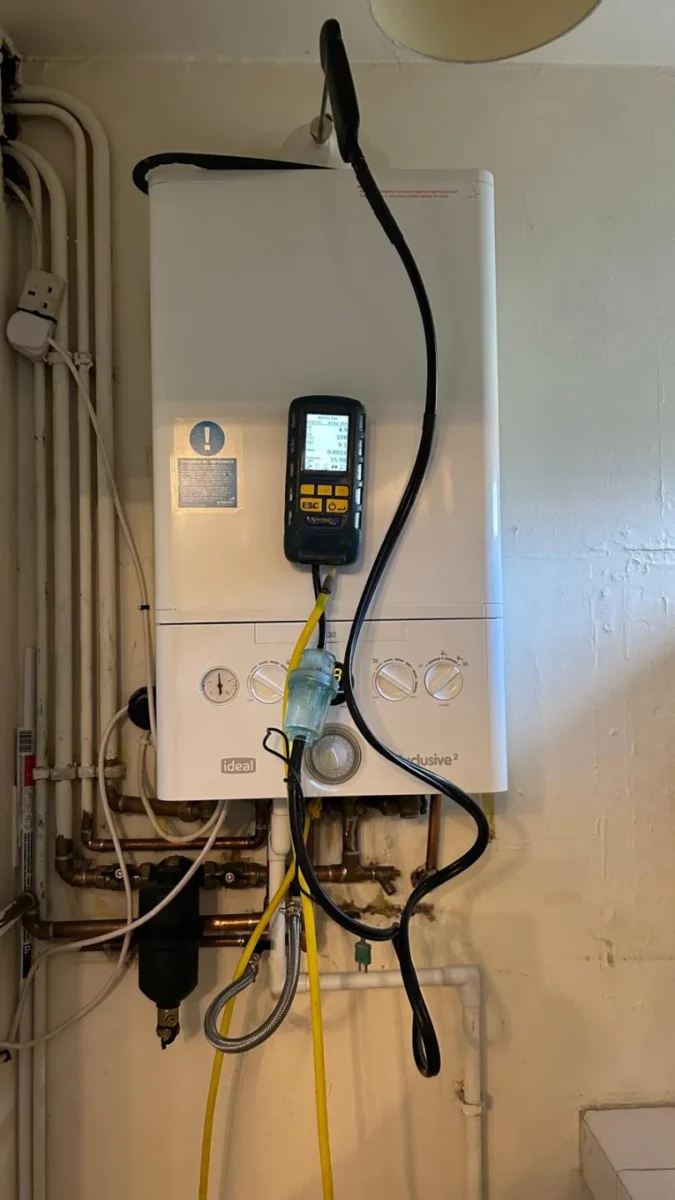
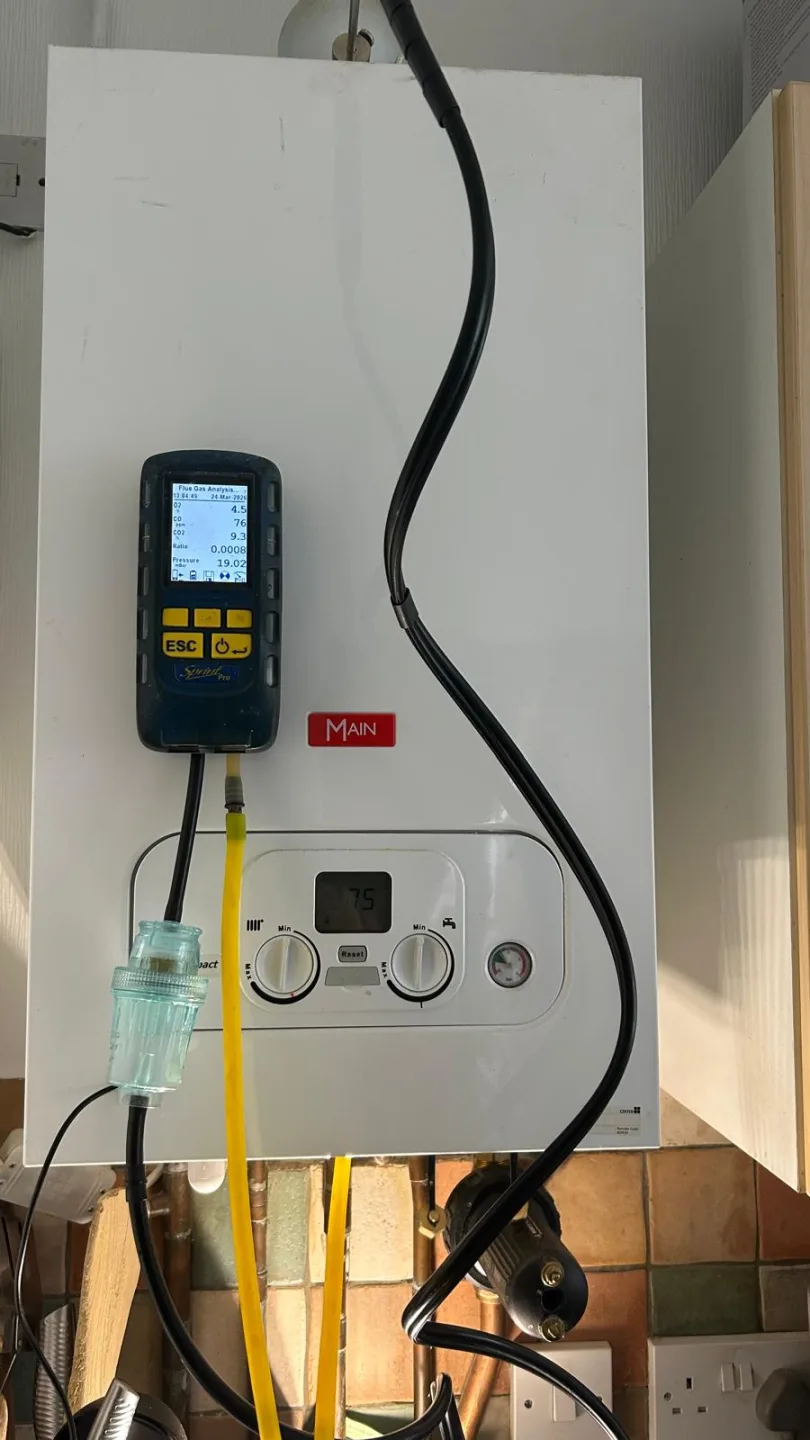
This is why an annual service matters. The engineer checks combustion with an analyser, inspects the flue and seals, and confirms the flue gases are leaving the building. Our article on flue gas analysis explains those readings in more detail. An alarm is the backstop for anything that goes wrong between visits.
What are the symptoms of carbon monoxide poisoning?
The common early signs are headaches, dizziness, nausea, tiredness, confusion and shortness of breath. Higher exposure can cause collapse and loss of consciousness. Because these overlap with everyday illnesses, CO poisoning is easy to miss without an alarm.
Patterns are often the giveaway:
- Symptoms that ease when you leave the house and come back when you return.
- Several people in the home, or pets, feeling unwell at the same time.
- Symptoms that get worse when the heating is on or the boiler is working hard.
- Visible signs at the appliance, such as sooty staining, a lazy yellow or orange flame on older open-flue appliances, or more condensation than usual in the room.
If you suspect CO exposure, get medical advice promptly and tell them you think carbon monoxide may be involved.
Where should you fit a carbon monoxide alarm?
Fit the alarm in the same room as the boiler, or the nearest sensible position if the boiler is in a cupboard, and in any other room with a fuel-burning appliance such as a gas fire or log burner. Always follow the alarm manufacturer's instructions, but the typical guidance looks like this.
| Situation | Typical position |
|---|---|
| Distance from the appliance | Between 1 and 3 metres horizontally |
| Ceiling mounted | At least 300mm away from any wall |
| Wall mounted | Higher than any door or window, and at least 150mm below the ceiling |
| Boiler in a cupboard | In the room just outside the cupboard, not squeezed inside it |
| Bedrooms | Worth adding one where people sleep, near breathing height |
Avoid putting an alarm directly above a sink or cooker, next to an extractor fan, or behind curtains or furniture where air does not move freely. Choose an alarm that meets BS EN 50291 and carries a recognised safety mark.
How do you test and look after a CO alarm?
Press the test button once a month and listen for the full alarm tone. If it is battery powered, change the batteries when prompted, or pick a sealed unit with a long-life battery. Every alarm has a limited sensor life, so check the replacement date on the back and replace it when that date arrives or it gives its end-of-life signal.
A simple habit is to test your smoke and CO alarms on the same day each month. Put the replacement date on your calendar when you fit a new one.
What must landlords in England provide?
Under the Smoke and Carbon Monoxide Alarm (Amendment) Regulations 2022, landlords of rented homes in England must fit a carbon monoxide alarm in any room used as living accommodation that contains a fixed combustion appliance, excluding gas cookers. They must also repair or replace an alarm once told it is faulty.
In practice that means the room with the boiler, and any room with a gas fire, solid fuel stove or oil appliance. Many landlords check alarms at the same time as the annual gas safety check, which keeps the records together. Our CP12 checklist covers the rest of a landlord's yearly gas duties, and HSE's gas safety guidance sets out the wider legal framework. Wales, Scotland and Northern Ireland have their own rules, so check the version that applies to you.
What should you do if your CO alarm goes off?
Treat it as real every time. Ventilate, switch off fuel-burning appliances if you safely can, get everyone outside and call the gas emergency number. Do not assume it is a false alarm because nobody feels ill, and do not go back in until you are told it is safe.
- Open doors and windows to let fresh air in.
- Turn off the boiler and other fuel-burning appliances if it is safe to do so.
- Get everyone, including pets, out of the property.
- Call the National Gas Emergency Service on 0800 111 999.
- Get medical help if anyone has symptoms.
- Do not use the appliance again until a Gas Safe registered engineer has checked it. Never remove the boiler casing yourself.
Once the emergency service has made the supply safe, the appliance will need investigating. If the engineer finds a fault, it will be classified and dealt with as explained in what happens if your boiler fails its service.
Booking a boiler safety check in Stoke-on-Trent
An alarm tells you something has gone wrong. A service helps stop it going wrong in the first place. Our annual boiler service in Stoke-on-Trent includes combustion analysis and flue checks, and we are happy to look at where your alarm is positioned while we are there. We also cover boiler service in Newcastle-under-Lyme and the surrounding towns.
Call 07896 677083 to book a visit at a time that suits you.
Frequently asked questions
Can I use a plug-in carbon monoxide alarm?
Yes, as long as it meets BS EN 50291 and the socket is in a suitable position, which is not always the case near a boiler. Many plug-in and mains alarms have a battery backup. A sealed battery unit is often easier because you can place it exactly where the guidance recommends.
Do I need a CO alarm if I have an electric cooker and a combi boiler?
Yes. The boiler is a fuel-burning appliance on its own, so the room it is in, or the space just outside its cupboard, should have an alarm. The type of cooker does not change that.
Does a gas cooker need a carbon monoxide alarm?
The 2022 rules for rented homes in England exclude gas cookers from the legal requirement. That does not mean they cannot produce carbon monoxide. Many homeowners choose to fit an alarm in the kitchen anyway, positioned away from the hob so cooking does not trigger it.
Why is my carbon monoxide alarm chirping?
A short chirp every so often usually means a low battery or that the alarm has reached the end of its sensor life. Check the manual, as the chirp patterns differ between makes. A continuous loud alarm is different and should always be treated as a real warning.
Sources and further reading

Gasmaster Plumbing & Heating has served Stoke-on-Trent since 2005. Every article is written by our Gas Safe registered engineers (reg. 220932) from day to day work on boilers, heating and gas appliances across Staffordshire, Cheshire and Derbyshire.