On this page
- Can a boiler actually fail a service?
- What do ID, AR and NCS mean?
- What happens if your boiler is Immediately Dangerous?
- What does At Risk mean for your heating?
- Do you have to act on Not to Current Standards advice?
- What should you do after a bad service result?
- Is it better to repair or replace?
- Getting a failed boiler sorted in Stoke-on-Trent
- Frequently asked questions
Quick answer
A boiler service is not a pass or fail test. If the engineer finds a problem, they classify it under the Gas Industry Unsafe Situations Procedure: Immediately Dangerous means disconnection with your permission, At Risk means turning it off, and Not to Current Standards is advice only. Minor wear is simply repaired or noted for later.
Key takeaways
- A service records the condition of your boiler; it does not issue a pass or fail.
- Immediately Dangerous means the appliance is disconnected and labelled, with your permission.
- At Risk means the boiler is turned off until the fault is fixed.
- Not to Current Standards is advice, not an instruction to stop using the boiler.
- Never use an appliance an engineer has labelled as unsafe.
Most boiler services end with a clean set of readings and a short note in the logbook. Occasionally the engineer finds something that needs more than a clean and a check, and the phrase people then use is that the boiler has "failed" its service. That word causes a lot of unnecessary worry, so it is worth knowing exactly what happens and what your options are.
Can a boiler actually fail a service?
Not in the way a car fails an MOT. A boiler service is an inspection and maintenance visit, and the outcome is a record of what was found and done. If the engineer finds a fault, it is either repaired, recommended for repair, or, if it is a safety issue, classified under a set procedure that every Gas Safe registered engineer follows.
Most findings are routine: a worn seal, a condensate trap that needs replacing, an ignition electrode past its best, or combustion readings that need adjusting. None of these mean your boiler is condemned. They mean a part or adjustment is needed, and the engineer should explain which ones matter now and which can wait.
If you want to know what a thorough visit covers in the first place, our boiler service checklist walks through each step.
What do ID, AR and NCS mean?
They are the three classifications in the Gas Industry Unsafe Situations Procedure, the industry procedure Gas Safe registered engineers use when they find something wrong with a gas appliance or installation. Each one carries a different level of urgency and a different action, from disconnection down to written advice.
| Classification | What it means | What the engineer does |
|---|---|---|
| Immediately Dangerous (ID) | A present danger to life or property if the appliance stays connected | Disconnects it from the gas supply with your permission and attaches a warning label |
| At Risk (AR) | One or more faults that could become dangerous | Turns the appliance off with your permission and labels it |
| Not to Current Standards (NCS) | Installed to older rules or with minor shortfalls, but not unsafe | Explains the issue and records advice; no action to turn it off |
You should be given paperwork that states the classification, what was found and what needs to happen next. Keep it with your boiler records.
What happens if your boiler is Immediately Dangerous?
The engineer will ask your permission to disconnect the boiler from the gas supply, usually by capping the gas pipe to it, and will attach a label saying it must not be used. The appliance stays off until the fault is repaired by a Gas Safe registered engineer.
Typical reasons include products of combustion spilling back into the room, a flue that is damaged or has come apart, or gas leaking from the appliance itself. In these cases the risk is carbon monoxide or fire, which is why the procedure is strict.
If a householder refuses permission to disconnect an Immediately Dangerous appliance, the engineer is expected to report it to the gas emergency service, which has powers to make the supply safe. Nobody wants it to come to that, and a good engineer will explain the reasoning clearly so it does not.
Do not reconnect or use a labelled appliance. The Gas Safety (Installation and Use) Regulations 1998 say a gas appliance must not be used if it is known or suspected to be dangerous. Never remove the boiler casing or undo the cap yourself. If you smell gas or suspect carbon monoxide, call the National Gas Emergency Service on 0800 111 999.
What does At Risk mean for your heating?
At Risk means the engineer has found a fault that could become dangerous, but is not an immediate threat. With your permission, they will turn the boiler off and label it. It is not normally disconnected from the gas supply, but it should not be used until the fault is put right.
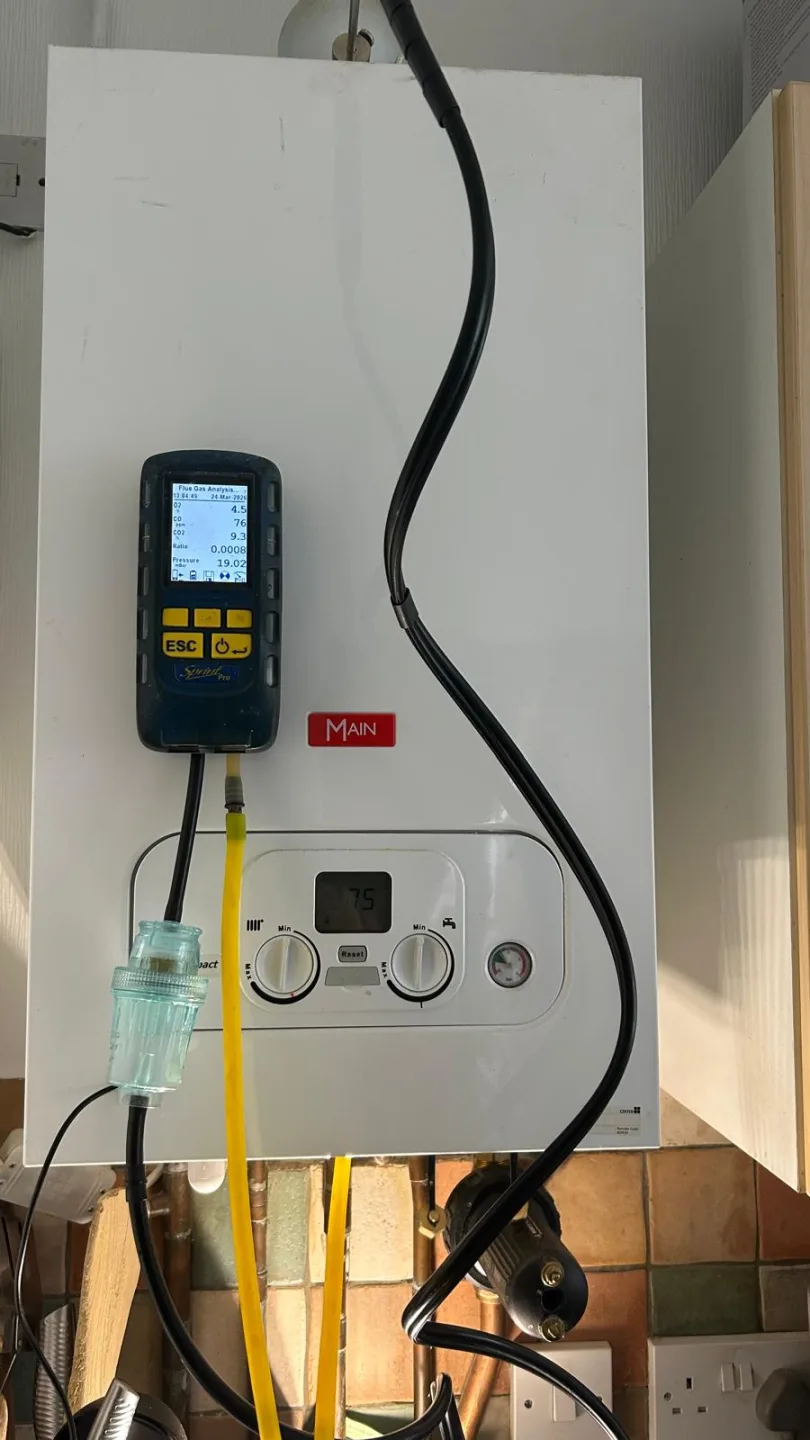
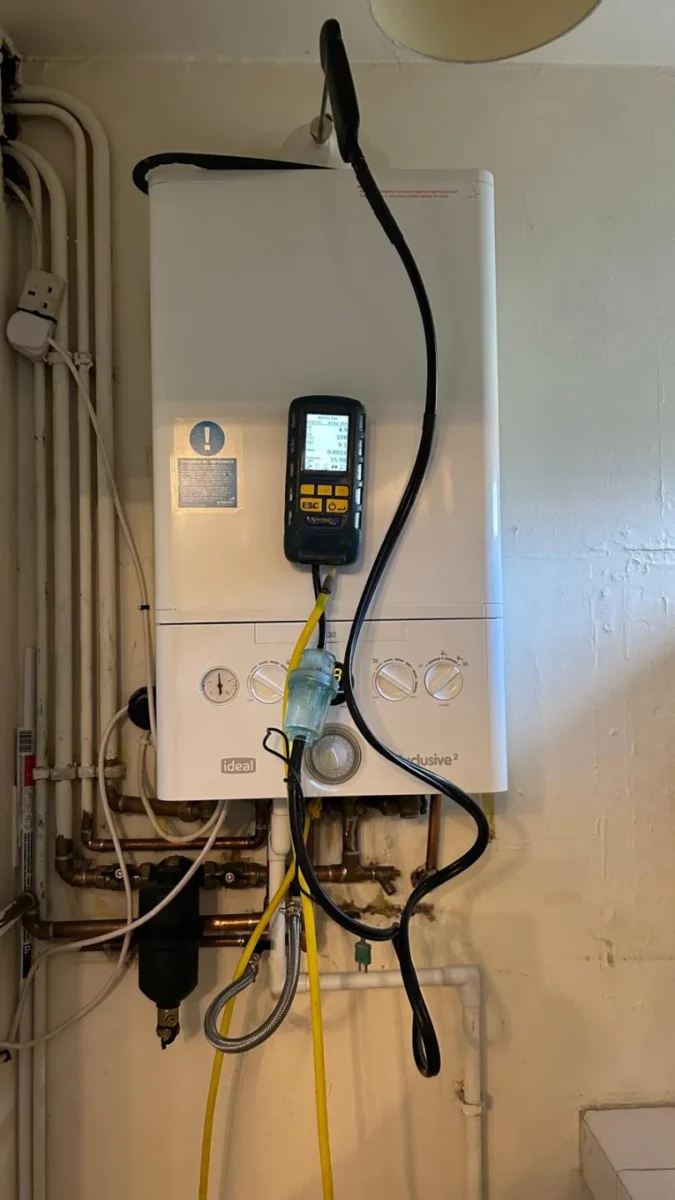
Common examples include combustion readings outside the manufacturer's limits, a flue terminal in a position that no longer suits the surroundings, or inadequate ventilation for the type of appliance. Our guide to flue gas analysis explains how those combustion readings are taken and what they tell the engineer.
Do you have to act on Not to Current Standards advice?
No. Not to Current Standards means the installation met the rules when it was fitted, or has a minor shortfall, but is not unsafe. The boiler can stay in use. The engineer records the issue so you can plan to bring it up to date, often when the boiler is next replaced or other work is done.
That said, NCS notes are worth reading properly. Some are cosmetic, while others, such as missing pipe sleeving through a wall, are simple fixes that are cheaper to sort while an engineer is already there.
What should you do after a bad service result?
Stay calm and get the facts in writing. Then follow a simple order:
- Read the service record and any warning notice so you know exactly which classification applies.
- Ask the engineer for a repair quote, including the parts needed and roughly how long they take to arrive.
- If you want a second opinion, check the new engineer is on the Gas Safe Register first.
- Arrange temporary heat for the affected rooms if the boiler is off, using safe portable electric heaters rather than anything that burns fuel.
- Once repaired, make sure the service is completed and the result is recorded in your Benchmark service record.
If you are a landlord, a fault found during a service or gas safety check also affects your paperwork, because an appliance classed as ID or AR cannot be shown as safe on the record until it has been repaired.
Is it better to repair or replace?
For most boilers under ten years old, a single fault found at service is a repair, not a reason to replace. Replacement becomes worth discussing when the fault is expensive, parts are hard to get, or the boiler has a history of repeated breakdowns.
Our existing guide on repair or replacement sets out the questions to ask before deciding either way.
Getting a failed boiler sorted in Stoke-on-Trent
If your boiler has been turned off or disconnected after a service, the next step is a proper diagnosis and repair. Our boiler repair service is charged at £90 per hour for the visit and diagnosis, and we will tell you what is needed before any work goes ahead. Once it is running safely we can complete the annual boiler service in Stoke-on-Trent and record it properly.
You can reach us on 07896 677083, seven days a week between 09:00 and 17:00.
Frequently asked questions
Can I get a second opinion if my boiler is labelled At Risk?
Yes. You are free to ask another Gas Safe registered engineer to look at it. Leave the boiler off in the meantime and keep the warning notice so the second engineer can see what was recorded. Check their registration on the Gas Safe Register before they start.
Will I be charged for the service if the boiler fails?
Usually yes, because the engineer has carried out the inspection and found the fault. What changes is the next step: a repair visit or parts order may be needed before the service can be fully completed. Ask how the service and repair will be charged before work continues.
Does a Not to Current Standards note affect selling my house?
It can come up if a buyer commissions a gas report, because the note will be visible in your records. An NCS item is not unsafe, but buyers may ask about it. Sorting simple items before you list the property can avoid questions later.
How long can my boiler stay off after being classed At Risk?
There is no set deadline, but it should not be used until repaired. In practice the time depends on the fault and part availability. Most common parts for popular makes can be sourced quickly, while older or obsolete boilers can take longer.
Sources and further reading

Gasmaster Plumbing & Heating has served Stoke-on-Trent since 2005. Every article is written by our Gas Safe registered engineers (reg. 220932) from day to day work on boilers, heating and gas appliances across Staffordshire, Cheshire and Derbyshire.