On this page
- What gas safety rules apply to an HMO?
- Which appliances need checking in an HMO?
- What about communal areas and shared kitchens?
- Do HMOs need carbon monoxide alarms?
- How do you give tenants the gas safety record?
- What if a tenant will not give access?
- Arranging HMO gas safety checks in Stoke-on-Trent
- Frequently asked questions
Quick answer
HMO landlords must have every gas appliance, flue and the pipework they provide checked by a Gas Safe registered engineer every year, keep them maintained, give each tenant a copy of the record, keep records for two years, and fit carbon monoxide alarms in rooms with fixed combustion appliances. Licensed HMOs usually also send the certificate to the council.
Key takeaways
- Every landlord-owned gas appliance and flue needs an annual safety check.
- Each tenant gets a copy of the record within 28 days of the check.
- Rooms with a fixed combustion appliance need a carbon monoxide alarm.
- Log every attempt to gain access in case a tenant does not allow it.
- Licensed HMOs usually have to give the council a current certificate.
An HMO puts more people, more cooking and more hot water demand on one gas installation than a typical family home. The legal duties are built on the same rules as any rented property, but the practical work of meeting them is bigger, and gaps are easier to miss.
What gas safety rules apply to an HMO?
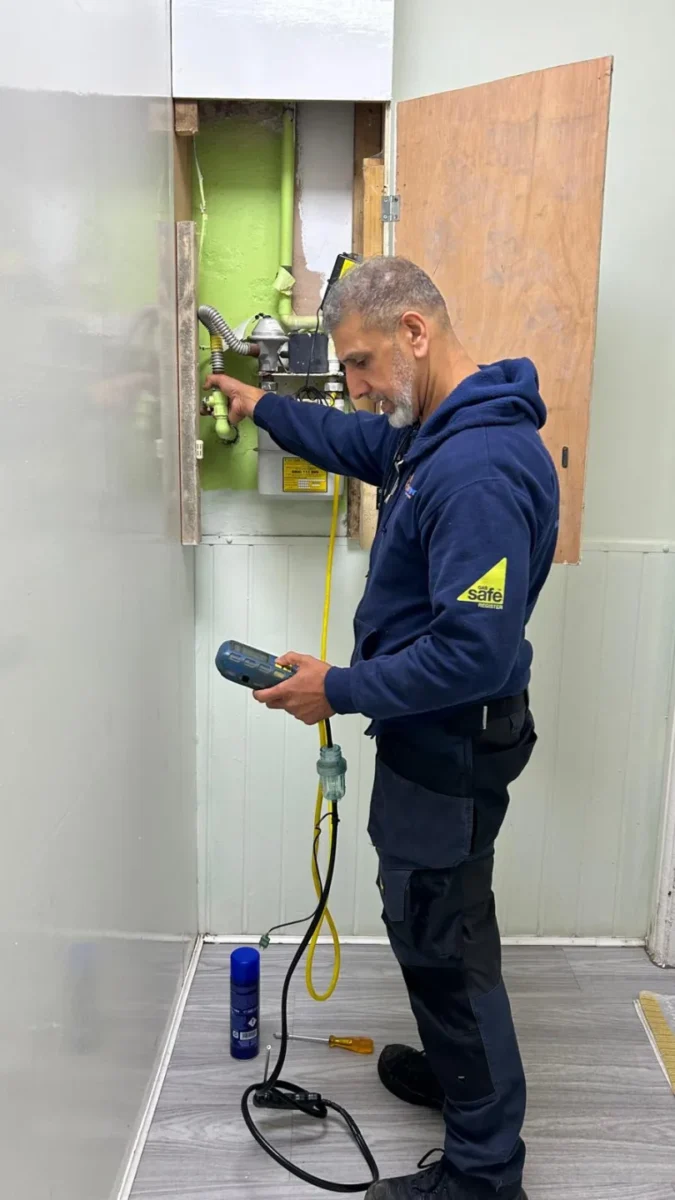
The core rules are the Gas Safety (Installation and Use) Regulations 1998, the same as for any let property. You must have gas appliances and flues you provide checked every year by a Gas Safe registered engineer, keep the installation maintained, share the record with tenants and keep records for two years.
On top of that, HMOs sit under their own management and licensing rules, which is where the council comes in. If your property is licensed, read the licence conditions carefully, because they commonly require you to produce a current gas safety certificate to the local authority each year. GOV.UK has an overview of HMO licensing, and your council's private housing team can confirm the local detail.
Which appliances need checking in an HMO?
Every gas appliance you provide, and every flue serving it, needs checking each year. In an HMO that is often more than one boiler, plus cookers in shared kitchens and sometimes gas fires in individual rooms or lounges. The engineer should also check the pipework and gas tightness of the installation.
A typical HMO record might list:
- One or two boilers, sometimes serving different floors or parts of the building.
- Gas hobs or cookers in one or more shared kitchens.
- Older gas fires in bedrooms or communal lounges, if they have been kept.
- The flue for each appliance, including any runs through voids or other rooms.
Appliances a tenant owns and brought with them are their responsibility, but tell tenants in writing that they should not install gas appliances of their own. Our CP12 checklist goes through what the engineer checks on each appliance.
What about communal areas and shared kitchens?
Communal areas are where HMO gas safety tends to slip. Shared kitchens get heavy use, pans get left on hobs, and ventilation gets blocked by tenants trying to keep the room warm. A boiler in a shared utility room can end up buried under laundry and bikes.
Build a quick look at these spaces into your routine inspections between annual checks. Look for blocked air vents, damaged hose connections on cookers, anything stored against a boiler or flue, and scorch marks above hobs. Report anything worrying to your engineer rather than waiting for the next annual visit.
Do HMOs need carbon monoxide alarms?
Yes. Under the Smoke and Carbon Monoxide Alarm (Amendment) Regulations 2022, rented homes in England need a CO alarm in any room used as living accommodation with a fixed combustion appliance, excluding gas cookers. In an HMO that includes any bedroom or lounge with a gas fire, and the room holding each boiler.
You must also repair or replace an alarm once you are told it is faulty. Our guide to carbon monoxide alarms and your boiler covers where to position them.
How do you give tenants the gas safety record?
Existing tenants must receive a copy within 28 days of the check, and new tenants before they move in. In an HMO with several separate tenancies, that means making sure each tenant gets their copy, not just the lead tenant or whoever happened to let the engineer in.
Where a tenant's room contains no gas appliance, the regulations allow the record to be displayed in a prominent place in the property instead. Many HMO landlords do both: they email every tenant and put a copy on the communal noticeboard.
| Duty | When | Practical tip |
|---|---|---|
| Annual gas safety check | Every 12 months, up to 2 months early keeps the date | Book all appliances on one visit |
| Copy to existing tenants | Within 28 days of the check | Email each tenant and keep proof |
| Copy to new tenants | Before they move in | Add it to your move-in pack |
| Keep records | At least 2 years | Store digitally with the tenancy file |
| CO alarms | Fitted and working | Test at each routine inspection |
What if a tenant will not give access?
You must take all reasonable steps to get the check done. Give written notice of the appointment, offer alternative times, and keep a record of every letter, email and text. If a room cannot be accessed, the engineer will note it on the record.
If a tenant reports a gas smell or a CO alarm sounding, they should call the National Gas Emergency Service on 0800 111 999 straight away, then let you know. Make sure that number is on the noticeboard in every HMO, alongside a reminder never to tamper with the boiler or remove its casing.
Keeping the log protects you if something goes wrong, and it usually shows up the tenant who needs a different time rather than one who is refusing outright.
Arranging HMO gas safety checks in Stoke-on-Trent
We carry out landlord gas safety certificates across Stoke-on-Trent and the surrounding towns, including properties with several boilers and shared kitchens. We can service the boilers on the same visit if you want both done together; our post on whether a boiler service includes a gas safety certificate explains the difference. For portfolios, our older guide to landlord boiler servicing duties is also worth a read.
Call 07896 677083 to talk through your property and book a date that works for your tenants.
Frequently asked questions
Does each room in an HMO need its own gas safety certificate?
No. One gas safety record normally covers the whole property, listing every appliance and flue that was checked. What matters is that every landlord-provided appliance is on it and that every tenant receives or can see a copy.
Can I use the same engineer for the gas check and the boiler service?
Yes, and it is often the most efficient way to do it. The two are different jobs with different paperwork, so make sure you ask for both when booking and allow enough time for the visit, especially with more than one boiler.
Are gas cookers in HMO kitchens covered by the annual check?
Yes, if you provide them. Landlord-supplied cookers and hobs are gas appliances and must be included in the annual safety check. They are only excluded from the carbon monoxide alarm requirement, not from the gas safety check itself.
What happens if an appliance fails the HMO gas check?
The engineer will classify the problem and, if it is unsafe, turn off or disconnect that appliance with your permission. It must stay out of use until it is repaired. The rest of the installation can often stay in use if it is safe.
Sources and further reading

Gasmaster Plumbing & Heating has served Stoke-on-Trent since 2005. Every article is written by our Gas Safe registered engineers (reg. 220932) from day to day work on boilers, heating and gas appliances across Staffordshire, Cheshire and Derbyshire.