On this page
- What is boiler flow temperature?
- Why does a lower flow temperature save gas?
- What flow temperature should you start with?
- How should hot water be set on a combi compared with a cylinder?
- How do you trial a lower flow temperature?
- When will a lower flow temperature not work well?
- Getting your heating set up properly in Stoke-on-Trent
- Frequently asked questions
Quick answer
For most homes with radiators, a heating flow temperature of around 60C is a sensible starting point, lower than the 70C to 80C many boilers are left at. It helps a condensing boiler condense. Hot water cylinders should still store water at 60C for legionella control. Trial a lower setting, then adjust.
Key takeaways
- Many boilers are left at a higher flow temperature than the house needs.
- Condensing boilers work best when return water is below about 55C.
- Cylinders should store hot water at 60C to control legionella.
- On a combi, the hot water dial is separate from the heating dial.
- Lower the setting in steps and watch how the house responds.
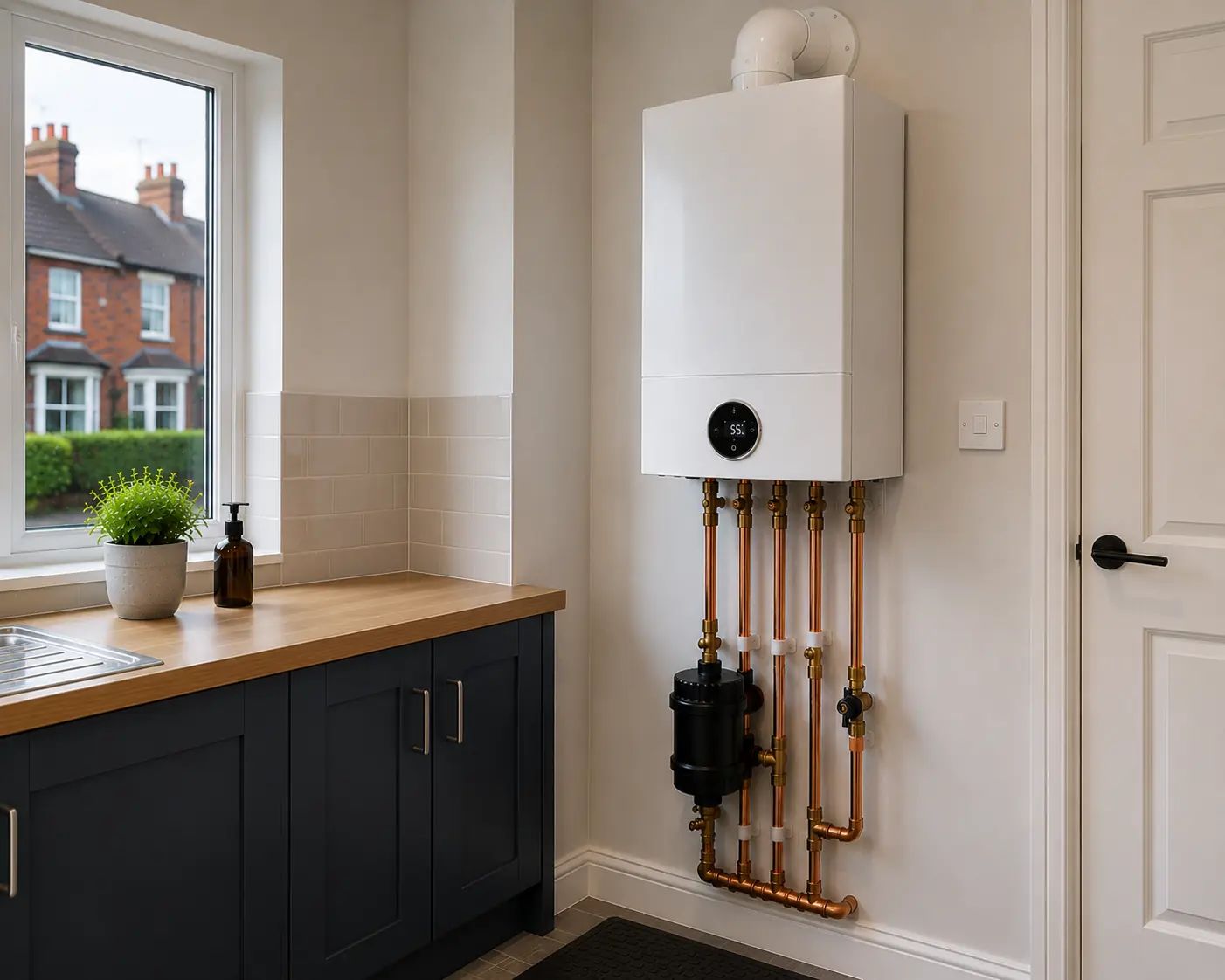
Look at the front of most combi boilers and you will see two controls, one marked with a radiator and one with a tap. The radiator dial sets the flow temperature, and it is often turned well up, either at installation or by someone who wanted the house to warm faster. Turning it down is one of the simplest efficiency changes you can make, as long as you understand what it does.
What is boiler flow temperature?
Flow temperature is how hot the water is when it leaves the boiler and heads to your radiators. It is different from your room thermostat setting, which is the air temperature you want in the house. The boiler heats water to the flow temperature, the radiators give off heat, and the cooler water returns to be heated again.
A higher flow temperature warms rooms faster but does not make them warmer in the end. The thermostat still switches off at the same room temperature. What changes is how efficiently the boiler gets you there.
Why does a lower flow temperature save gas?
A condensing boiler only condenses, recovering extra heat from its flue gases, when the water returning from the radiators is cool enough, broadly below about 55C. With the flow set at 75C or 80C, the return often stays above that, so the boiler behaves much like an older non-condensing model and sends usable heat out of the flue.
Lowering the flow temperature brings the return down into the range where condensing happens. The radiators feel warm rather than scorching, and they need to run a little longer to heat the room. If you want the boiler to make that adjustment automatically with the weather, see weather compensation explained.
What flow temperature should you start with?
For most homes with radiators, around 60C is a reasonable place to begin. Well-insulated homes, or those with generously sized radiators, may manage lower. Treat the figures below as starting points to try, not fixed rules, and always follow the limits in your boiler manual.
| Setting | Typical starting point | Notes |
|---|---|---|
| Radiator heating flow | Around 60C | Lower if rooms still reach temperature in cold weather |
| Hot water cylinder | 60C stored | For legionella control; do not set lower |
| Combi hot water | Comfortable at the tap | No storage, so no cylinder rule; lower reduces scale |
| Underfloor heating | Set by its mixing valve | Runs much cooler than radiators; follow the installer's settings |
How should hot water be set on a combi compared with a cylinder?
They are treated differently because a combi stores no hot water. Water is heated as it passes through, so there is no tank for bacteria to grow in, and the combi's hot water dial can be set to whatever is comfortable and safe at the tap. A cylinder stores water for hours, so it needs to be kept hot enough to control legionella.
The Health and Safety Executive's legionella guidance is based on stored hot water being kept at 60C or above. On a system or regular boiler, that means the cylinder thermostat stays at 60C, and the boiler must be able to reach it. If your controls heat the cylinder and radiators from one flow setting, your engineer can advise whether a separate hot water priority is possible so the radiators can run cooler.
In Stoke-on-Trent's hard water, a combi set very hot for hot water tends to scale up its plate heat exchanger faster. Setting it to a comfortable rather than maximum temperature helps, and our guide to no hot water but the heating works covers what happens when scale builds up.
How do you trial a lower flow temperature?
Change it in steps and give each step a few days of real use. The test that matters is a cold spell, so settings you choose in summer should be checked again once the heating is on every day.
- Note the current setting, or take a photo of the dial, so you can go back.
- Turn the radiator dial down by around 5C to 10C at a time.
- Leave your room thermostat where it is and watch whether rooms still reach it.
- If a room struggles, open its thermostatic radiator valve fully before raising the boiler setting.
- If the house still falls short in cold weather, go back up one step. That is your working setting.
When will a lower flow temperature not work well?
It struggles where radiators are undersized for their rooms, where some radiators are partly blocked with sludge, or where the house loses heat quickly. One cold room usually points to a specific radiator rather than the whole system. Our guide to radiators that are cold at the bottom covers the most common cause.
Do not reduce a cylinder below 60C to save energy, and do not change settings inside the boiler. Everything described here uses the controls on the outside of the boiler and your thermostat.
Getting your heating set up properly in Stoke-on-Trent
Summer is a good time to agree sensible settings, then fine-tune them as the evenings get colder. Our central heating engineers can check your flow and return temperatures, look at your controls and suggest settings that suit your radiators. We can also do it as part of an annual service.
We cover Stoke-on-Trent and nearby towns, including boiler service in Trentham and boiler service in Cheadle. Call 07896 677083 if you would like us to take a look.
Frequently asked questions
Will lowering the flow temperature damage my boiler?
No. Modern condensing boilers are designed to run at lower flow temperatures and to produce condensate. Just make sure the condensate pipe is correctly installed and insulated where it runs outside, because a boiler that condenses more produces more water through that pipe.
Why do my radiators feel only warm after turning the boiler down?
That is expected. At a lower flow temperature the radiators run cooler to the touch but for longer. What matters is whether the rooms reach the temperature on your thermostat. If they do, the setting is working.
Should I change the flow temperature in summer?
If your heating is off, the heating dial makes no difference in summer. On a combi, the hot water setting still applies all year. It is worth setting a sensible heating temperature now and reviewing it once you are using the heating daily.
Sources and further reading

Gasmaster Plumbing & Heating has served Stoke-on-Trent since 2005. Every article is written by our Gas Safe registered engineers (reg. 220932) from day to day work on boilers, heating and gas appliances across Staffordshire, Cheshire and Derbyshire.