On this page
- What is the black sludge in a heating system?
- How does a magnetic system filter work?
- Does a magnetic filter need cleaning, and who does it?
- What difference does a filter make to your boiler?
- Will a magnetic filter fix an existing sludge problem?
- Do you need a magnetic filter for a new boiler guarantee?
- Adding a magnetic filter in Stoke-on-Trent
- Frequently asked questions
Quick answer
A magnetic system filter is a canister fitted on the heating return pipe before the boiler. A strong magnet inside catches magnetite, the black iron oxide sludge that forms as radiators corrode, before it reaches the boiler's heat exchanger and pump. It is cleaned out at each annual service and is often required for new boiler guarantees.
Key takeaways
- Magnetite sludge comes from steel radiators and pipes slowly corroding inside.
- A filter catches sludge on the return pipe before it reaches the boiler.
- It must be cleaned at each service or it stops doing its job.
- A filter protects a clean system; it does not clean a dirty one on its own.
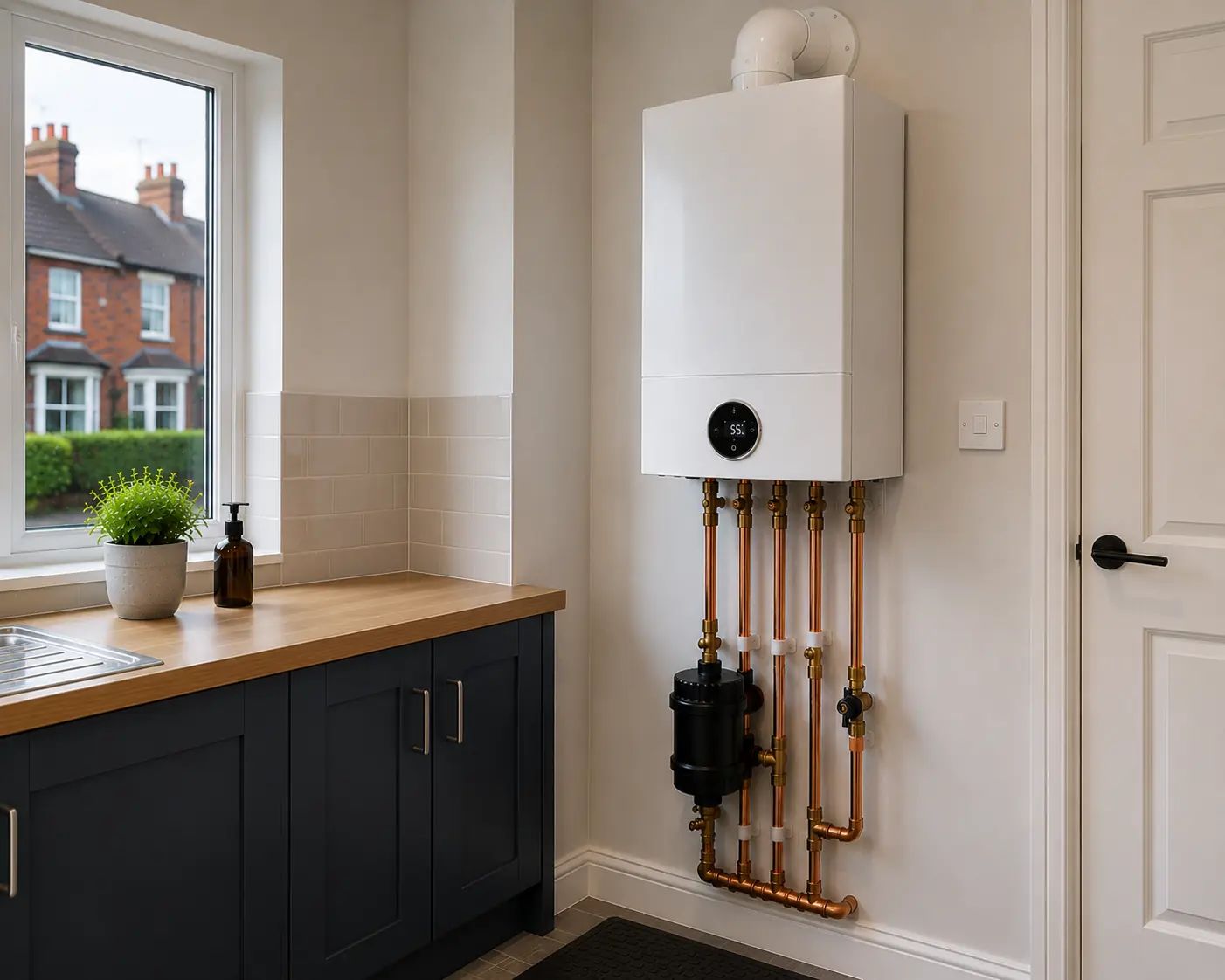
If your boiler was fitted in the last decade or so, there is a good chance a round canister sits on one of the pipes underneath it. That is a magnetic system filter. It does not look like much, but on a wet central heating system it is one of the cheapest ways to protect the most expensive parts of your boiler.
What is the black sludge in a heating system?
The black sludge is mostly magnetite, a form of iron oxide. It forms as the insides of steel radiators and other iron parts slowly corrode in the heating water. It builds up in radiators, pipes and the boiler itself, and it is strongly attracted to magnets, which is exactly what a magnetic filter takes advantage of.
Corrosion speeds up when air keeps getting into the system, when the inhibitor has been diluted by repeated topping up, or when a system has been drained and refilled without treatment. Every radiator bled and every drop of pressure topped up brings in a little fresh water and oxygen.
Left alone, sludge settles in the lowest and slowest parts of the system. Typical signs that it is building up include:
- Radiators hot at the top and cold along the bottom.
- Black water when a radiator is bled.
- A pump that sounds laboured or a boiler that kettles.
- Radiators that take much longer to warm up than they used to.
How does a magnetic system filter work?
A magnetic filter is fitted on the return pipe, the water heading back to the boiler. As water passes through the canister, a powerful magnet inside a sleeve pulls magnetite out of the flow and holds it. Many filters also have a mesh or baffles to catch non-magnetic debris such as sand, flux residue or scale.
Because it sits just before the boiler, the filter protects the parts that suffer most from sludge: the narrow waterways of the heat exchanger, the pump and, on a combi, the diverter valve and plate heat exchanger. It has isolating valves either side so it can be opened without draining the whole system.
Does a magnetic filter need cleaning, and who does it?
Yes. A filter only works while the magnet can still collect more sludge, so it needs cleaning at every annual service. The engineer isolates the filter, removes the magnet from its sleeve, flushes the collected debris out, checks the seals and refills the system. On a dirty system it may need attention more often.
Opening a filter releases water and system pressure, and the seals need to go back correctly or it will weep. It is a routine part of a boiler service in Stoke-on-Trent, so it is best left to your engineer rather than tackled on its own. What comes out of the filter also tells the engineer a lot about the condition of the rest of the system.
At your next service, ask the engineer to show you what came out of the filter. A thin grey film is normal. A thick black paste or a lot of grit suggests the system water needs treating or cleaning.
What difference does a filter make to your boiler?
A filter keeps sludge out of the boiler's heat exchanger and pump, which are the parts most likely to block, overheat or wear when the system water is dirty. Cleaner water means the boiler transfers heat properly, runs more quietly and is less likely to lock out on overheat faults.
Sludge in the heat exchanger is one of the common causes of noisy, inefficient boilers, and a failed pump or blocked plate heat exchanger is a common repair on systems that have never been protected. We cover the wider picture in how servicing extends the life of your heating.
Will a magnetic filter fix an existing sludge problem?
Not on its own. A filter catches sludge that is moving through the pipes, so it will gradually collect loose debris, but it cannot shift sludge that has already packed into the bottom of radiators. A heavily contaminated system usually needs cleaning first, with the filter fitted afterwards to keep it clean.
| Situation | Will a filter alone help? | Usual approach |
|---|---|---|
| Clean system, new boiler | Yes, as protection | Filter plus inhibitor, cleaned at each service |
| Mild sludge, radiators mostly warm | Partly | Chemical clean and flush, then filter and inhibitor |
| Radiators cold at the bottom | No | System clean or power flush first |
| Repeated pump or heat exchanger failures | No | Clean the system, then assess the boiler and fit a filter |
The approach to cleaning and treating heating water in the UK is set out in British Standard BS 7593, which covers cleansing, inhibitor and filtration. Your installer should follow it when fitting a new boiler, and any work on the boiler itself must be done by a Gas Safe registered engineer.
Do you need a magnetic filter for a new boiler guarantee?
Often, yes. Many boiler manufacturers make a system filter, along with a cleaned system and inhibitor, a condition of their longer guarantees. The exact terms vary by make and model, so check the guarantee paperwork rather than assuming. An annual service is usually a condition too.
Our Navien NCB300 combi packages include a magnetic filter as standard, alongside a wireless room thermostat and a five year warranty. If you are comparing quotes for a new boiler, check whether the filter and system clean are included or listed as extras.
On an existing boiler without one, a filter can usually be added with a modest amount of pipework. Late spring and summer are good times to do it, as the heating can be drained and refilled without anyone going cold.
Adding a magnetic filter in Stoke-on-Trent
If your system has no filter, or the one you have has not been opened in years, we can clean or fit one as part of our central heating work or at your annual service. We also cover boiler service in Stone and boiler service in Uttoxeter.
To ask about your system, call 07896 677083.
Frequently asked questions
How often should a magnetic filter be cleaned?
Once a year at the annual boiler service is the usual interval, which is also what most filter and boiler manufacturers expect. A system that has recently been cleaned, or one with a lot of sludge, may benefit from an extra clean a few months after installation while the loose debris is still being collected.
Where is the magnetic filter fitted?
It is normally fitted on the heating return pipe close to the boiler, so it catches debris just before the water enters the boiler. It needs enough space around it to be opened and cleaned, which is why installers usually place it under the boiler or in the same cupboard.
Does a magnetic filter replace inhibitor?
No. The filter removes sludge once it has formed, while inhibitor is a chemical added to the heating water to slow down the corrosion that creates sludge in the first place. The two work together, and inhibitor levels can be tested and topped up at the annual service.
Can a magnetic filter cause low boiler pressure?
A filter should not lose pressure if its seals are sound. If pressure starts dropping after a filter has been opened, a seal may not have seated properly or may be worn. Check under the filter for drips and ask your engineer to look at it rather than repeatedly topping up.
Sources and further reading

Gasmaster Plumbing & Heating has served Stoke-on-Trent since 2005. Every article is written by our Gas Safe registered engineers (reg. 220932) from day to day work on boilers, heating and gas appliances across Staffordshire, Cheshire and Derbyshire.