On this page
- Finding your boiler and working out what type it is
- Finding the emergency gas shut-off valve and stopcock
- Reading the data plate and Benchmark log
- Why booking a baseline service makes sense even if it seems fine
- Setting up a carbon monoxide alarm
- Why annual servicing protects safety and any inherited warranty
- Book with Gasmaster
- Frequently asked questions
Quick answer
As a first-time buyer, locate your boiler and identify whether it is a combi, system or regular type, find your gas shut-off valve and stopcock, check for a Benchmark log book, and book a baseline service even if everything seems fine. This establishes a safety and maintenance starting point and protects any warranty you may have inherited.
Key takeaways
- Identify your boiler type by looking for a hot water cylinder and loft tank, or the absence of both for a combi.
- Locate the emergency gas shut-off valve and the stopcock before you need them in a hurry.
- Check the data plate and Benchmark log book, if left behind, for the boiler’s age and service history.
- Book a baseline service soon after moving in, even if the boiler appears to work fine.
- A working carbon monoxide alarm is essential and cheap to fit if one is not already present.
Buying your first home is a genuine milestone, and it comes with a list of systems and appliances that nobody explains to you until you own them. The boiler is one of the biggest ones, both for your comfort and for your safety, so it is worth spending twenty minutes getting familiar with it in your first week.
Finding your boiler and working out what type it is
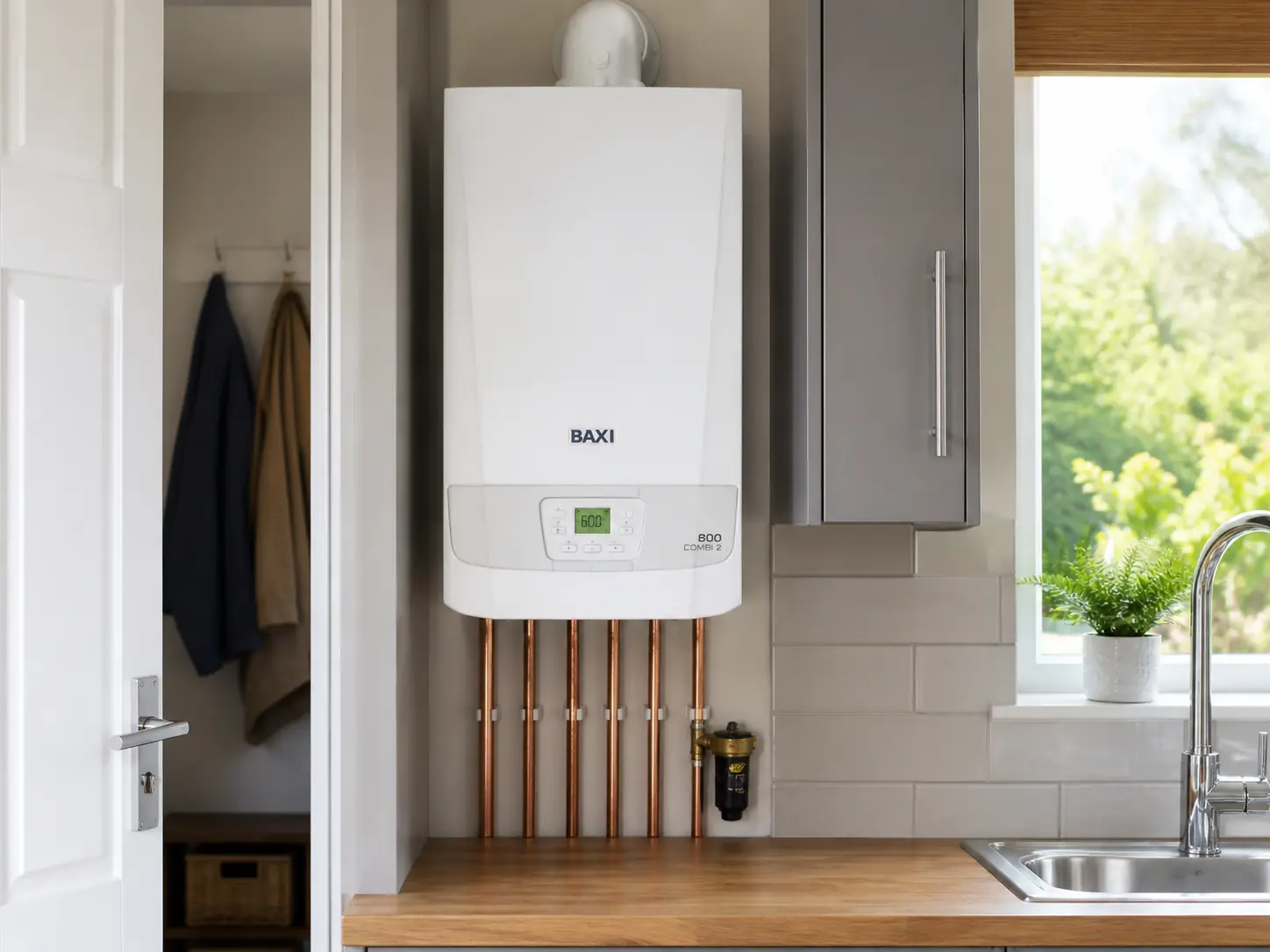
Boilers are usually tucked away in a kitchen cupboard, utility room, airing cupboard, or occasionally a loft or garage. Once you have found it, you can usually tell the type at a glance:
- A combi boiler has no separate hot water cylinder anywhere in the house. It heats water directly on demand.
- A system boiler has a hot water cylinder, usually in an airing cupboard, but no cold water tank in the loft.
- A regular (conventional) boiler has both a hot water cylinder and a cold water tank (sometimes two tanks) up in the loft.
Knowing which you have matters for everything from how quickly hot water runs out to what a new boiler installation would involve if yours ever needs replacing.
Finding the emergency gas shut-off valve and stopcock
Two things worth locating before you ever have an emergency: the gas emergency control valve, usually a lever near your gas meter, and the mains water stopcock, most often under the kitchen sink or near where the water main enters the house. Our detailed guide on how to find and test your stopcock walks through this in more depth. Knowing where both are, and that they turn freely, means you are not searching for them in a panic if you ever smell gas or spring a leak.
Reading the data plate and Benchmark log
Every boiler has a data plate, usually inside or on the front panel, giving the model, serial number and technical specifications. If the previous owner left behind a Benchmark log book, it will tell you the installation date and, crucially, the history of services carried out since. This is genuinely useful information: it tells you how old the boiler is, whether it has been looked after, and whether any manufacturer warranty might still be active. No log book does not necessarily mean no history, previous owners sometimes lose it, but it is worth asking your solicitor whether the sellers provided one.
Why booking a baseline service makes sense even if it seems fine
It is tempting to leave a boiler alone if it seems to be heating the house and providing hot water without complaint. The trouble is you have no way of knowing when it was last serviced, or by whom, or to what standard. Booking a boiler service in your first few months gives you a documented starting point: a qualified engineer checks it thoroughly, flags anything that needs attention early, and you now have your own service record going forward rather than an unknown history you inherited. It is a small cost against genuine peace of mind in a home you have just committed a significant amount of money to.
Setting up a carbon monoxide alarm
If the property does not already have a carbon monoxide alarm, or you are not confident the existing one is working, this should be an early priority. CO alarms are inexpensive, simple to fit, and give you an early warning if a gas appliance develops a fault that produces carbon monoxide, a gas you cannot see or smell yourself. Our guide on carbon monoxide alarms and your boiler explains where to position one and what to do if it goes off.
Why annual servicing protects safety and any inherited warranty
Many newer boilers come with manufacturer warranties of anything from two to twelve years, but almost all of them are conditional on the boiler being serviced annually by a qualified, Gas Safe registered engineer. If you inherited a boiler with years of warranty remaining, missing a service could invalidate it entirely, an expensive mistake if the boiler later develops a fault that would otherwise have been covered. Treat the annual service as non-negotiable, both for safety and to protect whatever warranty you may have inherited with the property.
Book with Gasmaster
Just moved into your first home and want a professional to check the boiler over? Gasmaster is Gas Safe registered (220932), based in Stoke-on-Trent and covering Newcastle-under-Lyme, Trentham and Stone. Book your baseline boiler service online and start your ownership with a clear, documented history.
Frequently asked questions
How do I know what type of boiler I have as a first-time buyer?
Check whether you have a separate hot water cylinder, usually in an airing cupboard. No cylinder means a combi boiler; a cylinder with no loft tank means a system boiler; a cylinder plus a loft tank means a regular boiler.
Is it normal not to get a Benchmark log book when buying a house?
It happens fairly often, particularly with older properties or when sellers have misplaced it. Ask your solicitor whether one was provided, and if not, your gas engineer can start a fresh service history from your first visit.
Do I need to service a boiler that seems to be working perfectly fine?
Yes. Annual servicing checks for safety issues that are not visible from normal use, such as early carbon monoxide risks or wear that has not yet caused a breakdown, and it protects any manufacturer warranty.
Where should I fit a carbon monoxide alarm in relation to the boiler?
General guidance is to fit it in the same room as the boiler, but not directly above it, and at head height or on the ceiling, following the manufacturer’s specific instructions for the model you buy.
What should I do first if I smell gas in my new home?
Turn off the gas at the emergency control valve, open windows and doors, do not use switches or naked flames, and leave the property to call the National Gas Emergency Service. Locate your shut-off valve in advance so you are not searching for it during an emergency.
Sources
- Gas Safe Register (gassaferegister.co.uk)
- HSE (Health and Safety Executive)
- Energy Saving Trust
- Which?
Related services

Abdul runs Gasmaster Plumbing & Heating and has worked on boilers, heating and gas appliances across Stoke-on-Trent since 2005. He is Gas Safe registered (reg. 220932), and these articles come from his day to day work in homes and businesses across Staffordshire, Cheshire and Derbyshire.