On this page
- What does a boiler condensate pipe do?
- Where does a condensate pipe usually drain to?
- What does the engineer check on the condensate during a service?
- How can you tell if your condensate pipe is blocked?
- What size should an external condensate pipe be?
- Why sort out the condensate pipe in spring rather than winter?
- Booking a boiler service in Stoke-on-Trent
- Frequently asked questions
Quick answer
A boiler condensate pipe carries mildly acidic water away from a condensing boiler to a drain. At a service, a Gas Safe registered engineer should clean or flush the condensate trap where the manufacturer requires it, check seals for leaks, and check the pipe run falls correctly, is supported, and is not blocked or undersized outside.
Key takeaways
- Every condensing boiler has a condensate trap and pipe, and a blockage makes it lock out.
- Trap cleaning happens inside the casing, so it is always an engineer's job.
- External runs should be at least 32mm, short, insulated and falling steadily.
- Spring is the easiest time to correct a badly routed pipe before the frosts.
Every condensing boiler makes water as it burns gas, and that water has to go somewhere. The condensate pipe is the plain plastic pipe that carries it away, and when it blocks or freezes the boiler shuts itself down. Here is what a Gas Safe registered engineer should be looking at on that pipe during your annual service.
What does a boiler condensate pipe do?
A condensate pipe drains the water a condensing boiler produces when it recovers heat from its own flue gases. That water is mildly acidic, so it passes through a trap inside the boiler and then out through a plastic pipe to a drain, soakaway or internal waste. If it cannot drain, the boiler locks out.
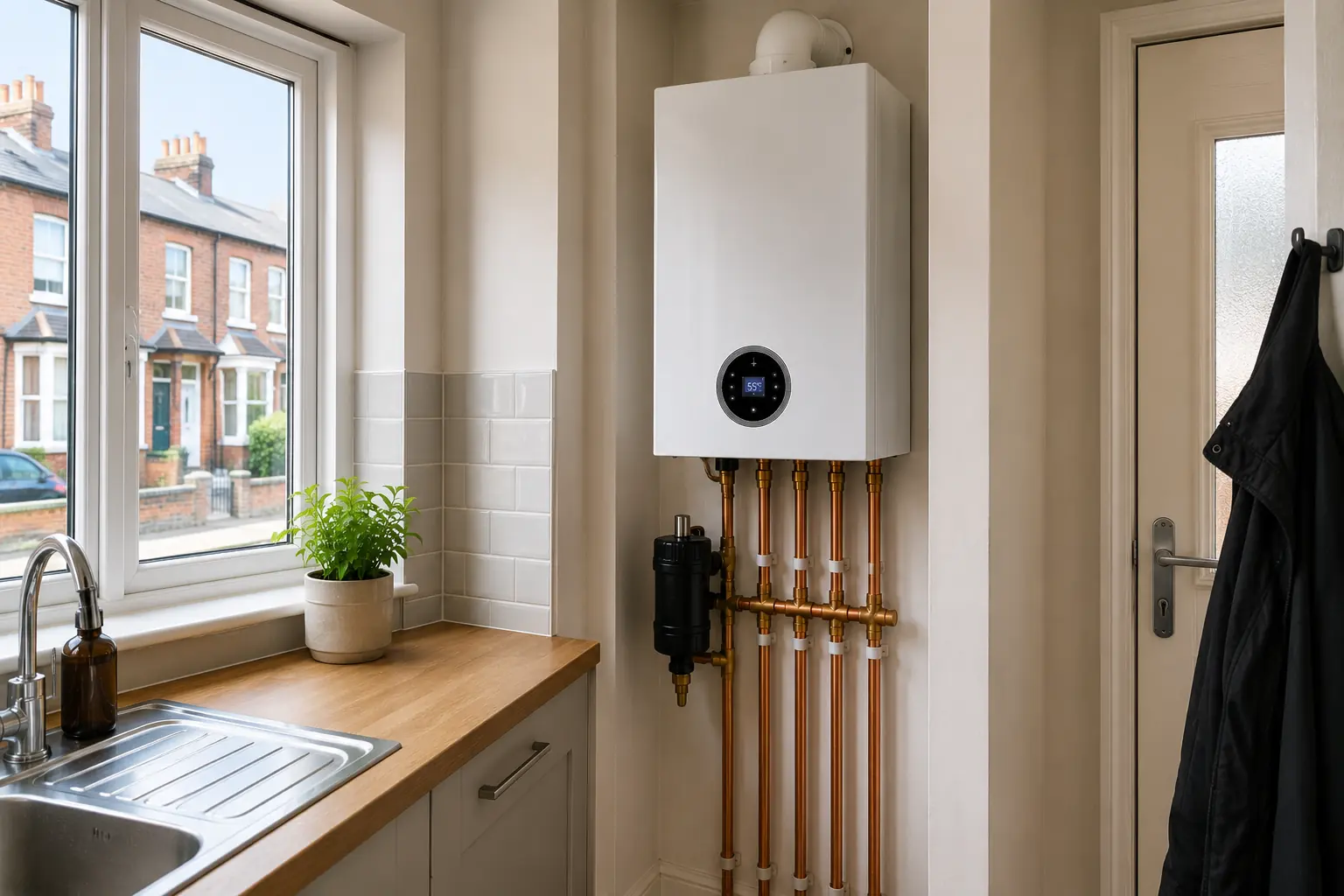
Condensing boilers became the standard for most new gas installations in England and Wales in 2005, so if your boiler is younger than that it almost certainly has one. Look underneath it: alongside the copper gas and water pipes you will usually see a white or grey plastic pipe of about 22mm. That is the condensate.
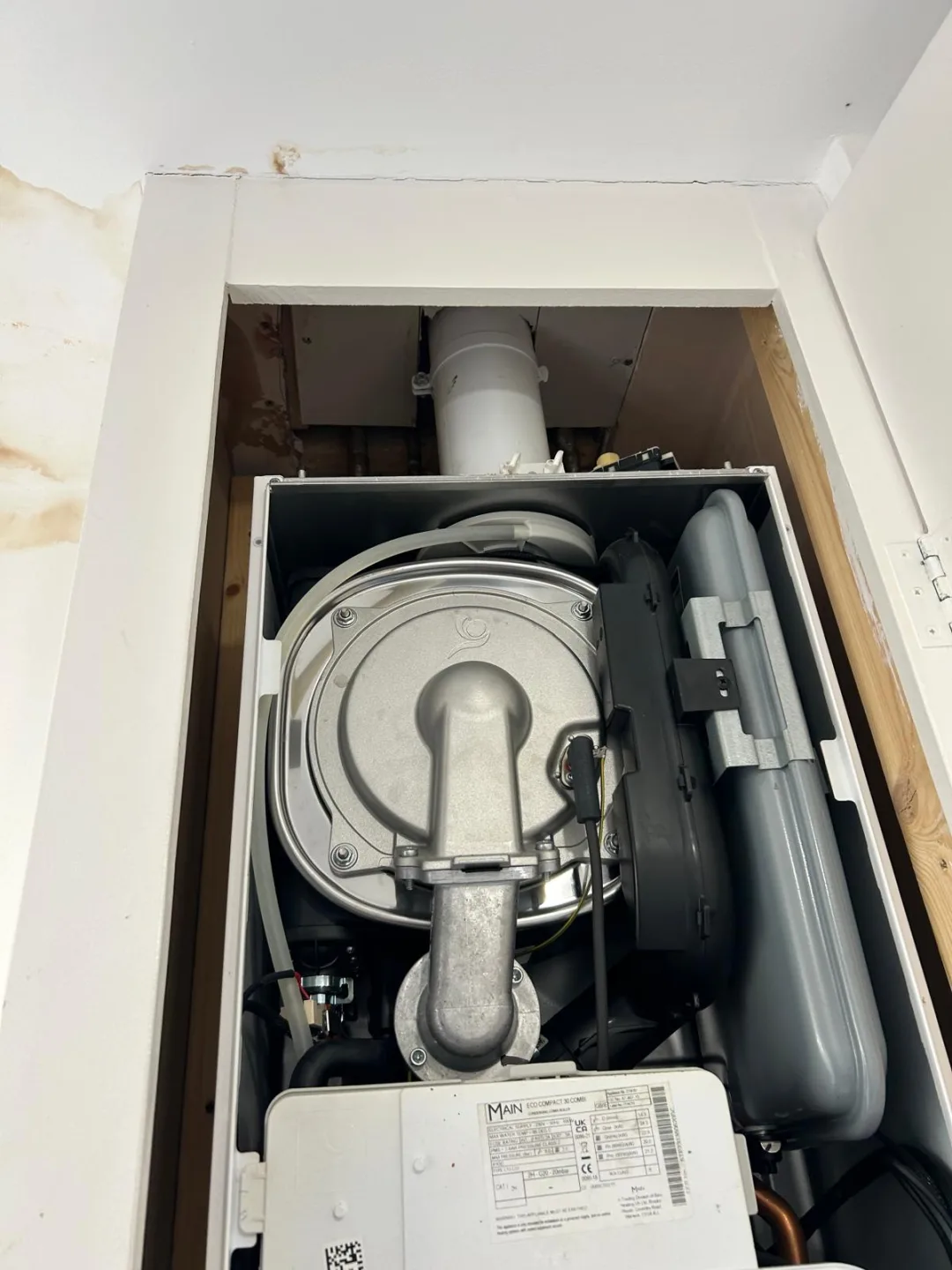
The trap works much like the U-bend under a sink. It holds a small amount of water to stop flue gases escaping into the drain, and it is also where sediment and debris collect over the year.
Where does a condensate pipe usually drain to?
The preferred route is into an internal waste, such as a kitchen sink waste or an internal soil stack, because the pipe stays inside the warm house. Where that is not possible, installers run it outside to a gully, an external soil stack or a purpose-built soakaway. The external runs are the ones that cause most winter trouble.
| Where it ends | Freezing risk | What to watch for |
|---|---|---|
| Internal soil stack or sink waste | Low | Correct connection so smells and waste cannot back up |
| External gully or drain | Medium | Short exposed length, insulated, end not blocked by leaves |
| External soil stack | Medium | Long vertical drops outside freeze in hard frosts |
| Soakaway | Higher | Pipe buried in soil or ending in a bare hole |
| Condensate pump | Low | Pump and reservoir need checking at each service |
What does the engineer check on the condensate during a service?
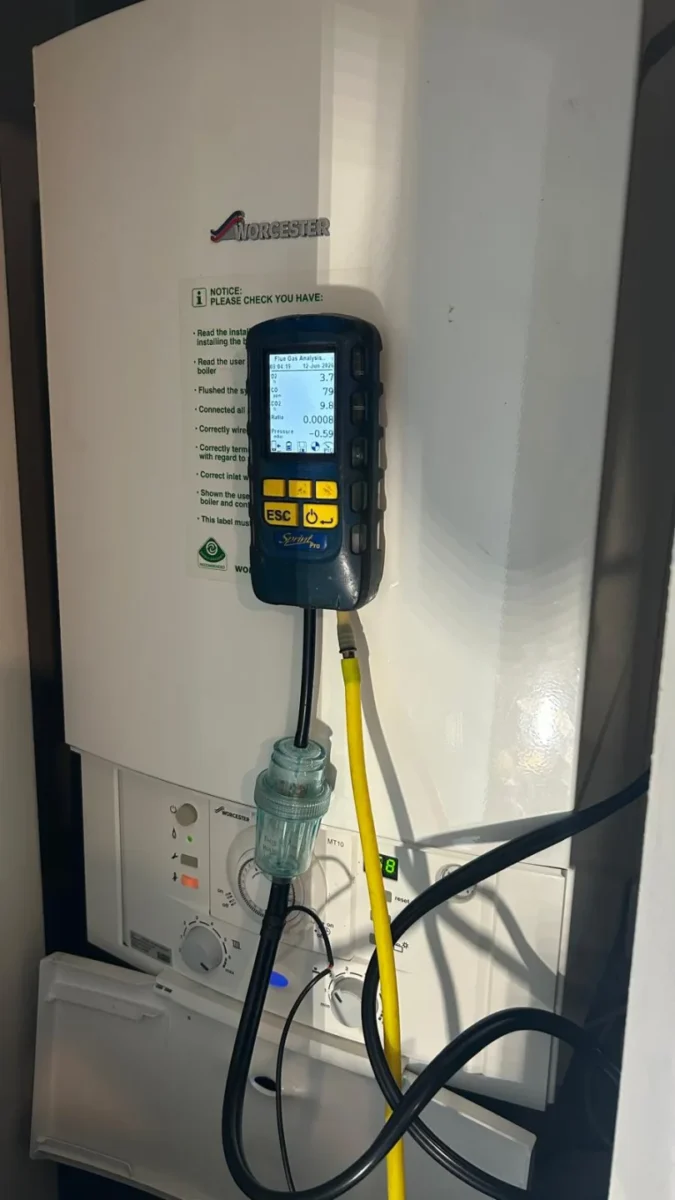
On an annual service the engineer inspects the condensate trap, cleans or flushes it where the manufacturer's instructions call for it, checks the trap and its seals for leaks, and follows the pipe run to make sure it falls correctly, is properly supported and has not been crushed, split or disconnected.
- Removes and cleans the trap or siphon where the boiler design allows, then refills it with water before refitting so flue gas cannot escape.
- Checks seals and joints inside the casing for weeping, since drips can reach electrical parts.
- Checks the pipe has a steady fall along its whole length, with no dips where water can sit.
- Looks at clips and supports, because a sagging section holds water and freezes first.
- Checks the outside end is not crushed, clogged with leaves or buried in a flowerbed.
- If a condensate pump is fitted, checks it runs and that its reservoir is clean.
These checks sit alongside the combustion, gas pressure and safety checks covered in our boiler service checklist.
Leave the trap to the engineer. On most boilers the condensate trap sits inside the sealed casing, next to gas connections, the combustion chamber and live electrics. Never remove the boiler casing to get at it yourself. Only a Gas Safe registered engineer should work inside it.
How can you tell if your condensate pipe is blocked?
The most common sign is a boiler that lights, runs briefly and then locks out with a fault code, often with a gurgling noise from inside. In cold weather the cause is usually ice in an outside run. In the warmer months it is more likely sediment in the trap or a pipe that has been knocked or crushed.
- Gurgling or bubbling from the boiler as it fires.
- A fault code that your manual links to condensate, flame loss or ignition (codes vary by make).
- Water dripping from the bottom of the casing.
- An outside pipe that is split, disconnected or sitting in a puddle.
- The boiler works after one reset, then fails again within minutes.
Resetting once, following the manual, is reasonable. If it keeps failing, stop resetting and have it looked at. A trap choked with debris will not clear itself.
What size should an external condensate pipe be?
Industry guidance is that condensate pipe running outside should be at least 32mm in diameter, kept as short as possible and insulated with weatherproof lagging. Inside the house, pipe of around 22mm is normal. Plenty of older installations have a thin external run, and those are the ones most likely to freeze.
The wider bore matters because a narrow pipe can freeze solid overnight in a hard frost, while a larger insulated pipe takes much longer to close up. The fall matters just as much. The boiler's installation manual sets a minimum gradient, and a run that is level or sags in the middle holds water exactly where ice forms first.
This is worth thinking about in the higher parts of our area. Homes around Biddulph Moor and up towards the Peak see longer, harder frosts than central Stoke, so we pay particular attention to exposed runs when carrying out a boiler service in Biddulph or a boiler service in Buxton.
Why sort out the condensate pipe in spring rather than winter?
Because in May nobody's boiler is locking out on a frozen pipe, so there is time to reroute, upsize or insulate it properly. In January the same problem becomes an emergency thaw on a cold morning, and the underlying fault usually stays in place until the next cold snap.
If your engineer notes that the external run is undersized, unsupported or poorly routed, ask for a price to correct it while the weather is mild. Moving the pipe to an internal waste is often the most reliable fix where the layout allows it. For other ways to cut your risk of a winter failure, see our guide to avoiding boiler breakdowns in winter.
Before your service, take a photo of where the condensate pipe leaves the house and where it ends. If it disappears into soil or a flowerbed, mention it when you book so the engineer can bring the right fittings.
Booking a boiler service in Stoke-on-Trent
Condensate checks are part of every annual boiler service in Stoke-on-Trent we carry out, and a standard service is £90. If the pipe run needs work, you will get a plain explanation and a price before anything is done.
To book, or to ask whether your pipe run looks right, call 07896 677083. We are open seven days a week, 9am to 5pm, and cover Stoke-on-Trent, Staffordshire, south Cheshire and Derbyshire.
Frequently asked questions
Can I clean the condensate trap myself?
No. On most boilers the trap is inside the sealed casing, alongside gas and electrical components, so it should only be removed and cleaned by a Gas Safe registered engineer. What you can safely do is look at the external pipe and make sure its outlet is clear of leaves, soil and debris.
Is it normal for the condensate pipe to drip outside?
Yes. While the boiler is running in condensing mode you will often see drips or a small trickle from the end of the pipe, especially when the heating is on. A constant flow when the boiler is off, or water escaping from a joint partway along the run, is not normal and should be checked.
Can a condensate pipe go into a rainwater downpipe?
Usually it should not. Condensate is mildly acidic waste water and belongs in the foul drainage system or a properly built soakaway. A rainwater downpipe that feeds a surface water drain is generally not a suitable route. Your engineer can tell you whether your existing arrangement is acceptable.
Does a condensate pump need servicing?
Yes. Where the boiler has no gravity route to a drain, a small pump lifts the condensate away. Its reservoir can collect sludge and the pump itself can fail, which will lock the boiler out. It is worth asking your engineer to check it at each annual service.
Sources and further reading

Gasmaster Plumbing & Heating has served Stoke-on-Trent since 2005. Every article is written by our Gas Safe registered engineers (reg. 220932) from day to day work on boilers, heating and gas appliances across Staffordshire, Cheshire and Derbyshire.